

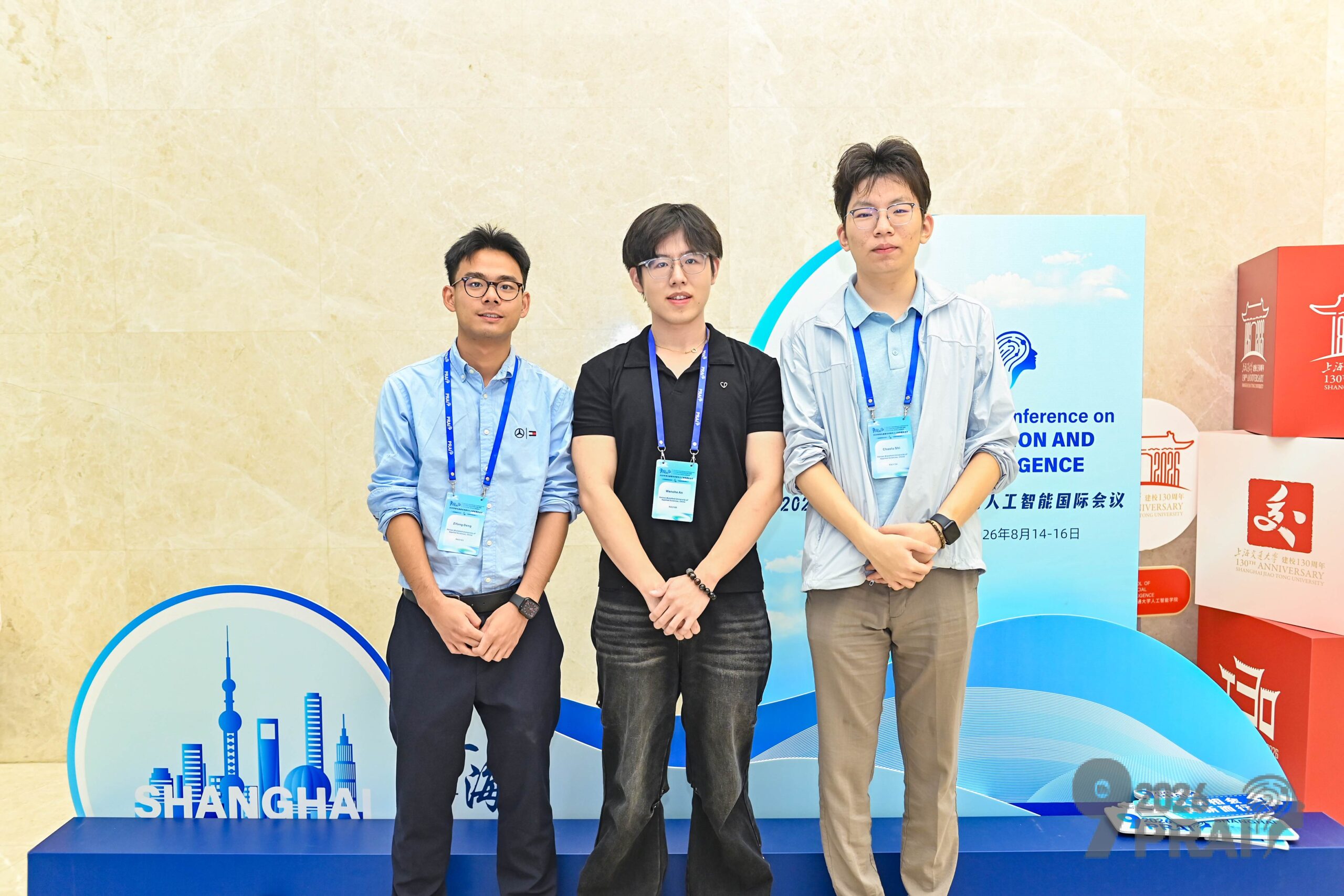
2026年8月14日至16日,第九届模式识别与人工智能国际会议(PRAI 2026)在上海举行。我校邓梓丰、安文彻、史朝鲁三位同学携论文参会,完成了学术报告。三篇论文、三场汇报、三份成长感悟,记录了他们从课堂走向国际学术现场的一步。
邓梓丰:在受控实验中界定可检测性边界
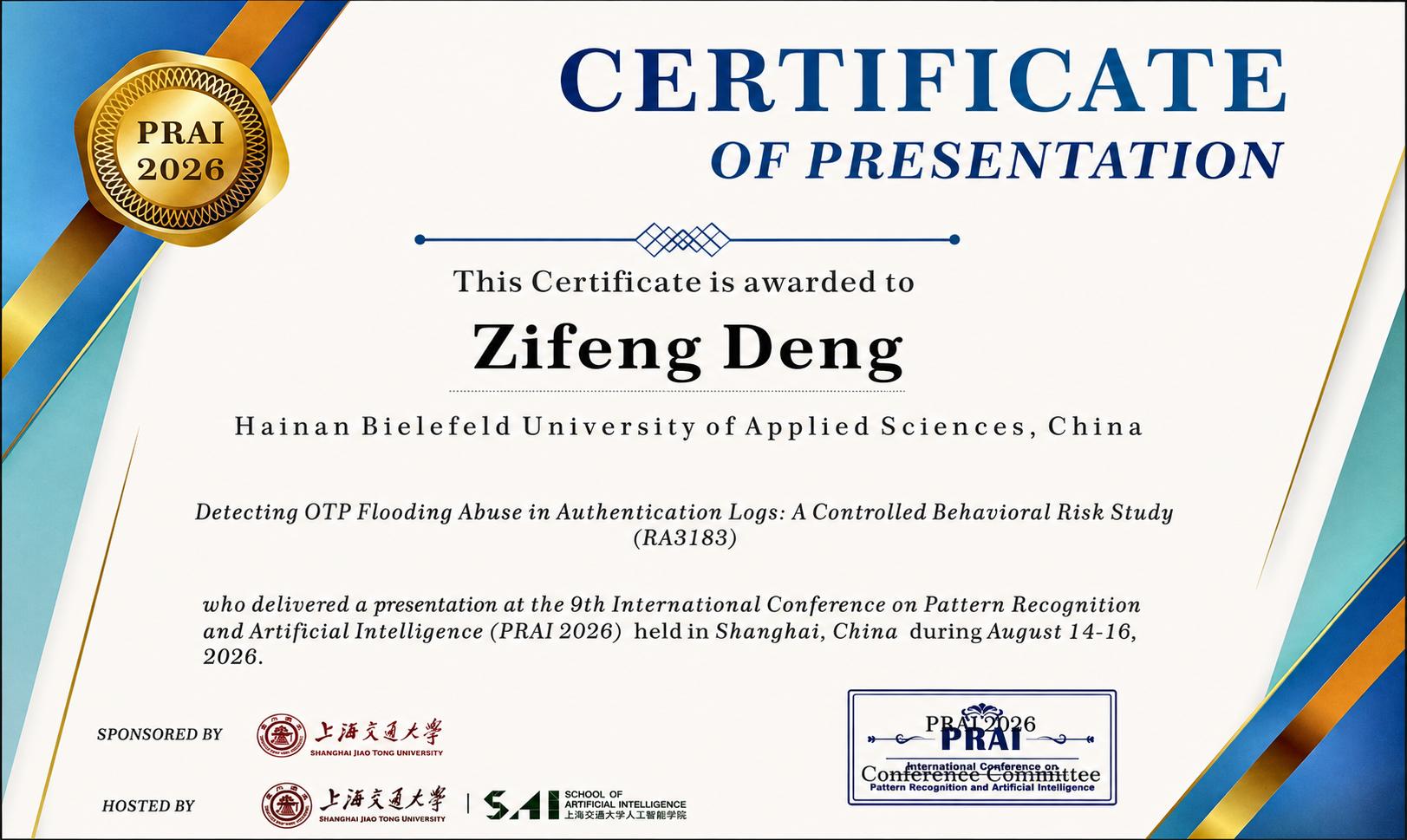
“科研交流,重点在于分享观点、探讨问题,从多元视角中汲取新知。”—— 邓梓丰
在参会之前,我已经持续参与科研近一年。从阅读论文、尝试方法,到修复实验问题、反复重跑,我逐渐认识到,科研很少来自“突然出现的好点子”,更多是把一个个小问题耐心解决、验证并改进。现场交流让这种认识更加具体。
我与硕士生、博士生和不同方向的研究者讨论市场预测、轻量 YOLO、机器人等主题,也从交流中获得了对自己其他研究方向的新启发。
对我而言,这次会议最重要的收获,不只是完成了一次报告,而是发现过去那些安静的阅读、调试和积累,已经逐渐变成能够与他人交流的真实研究经验。
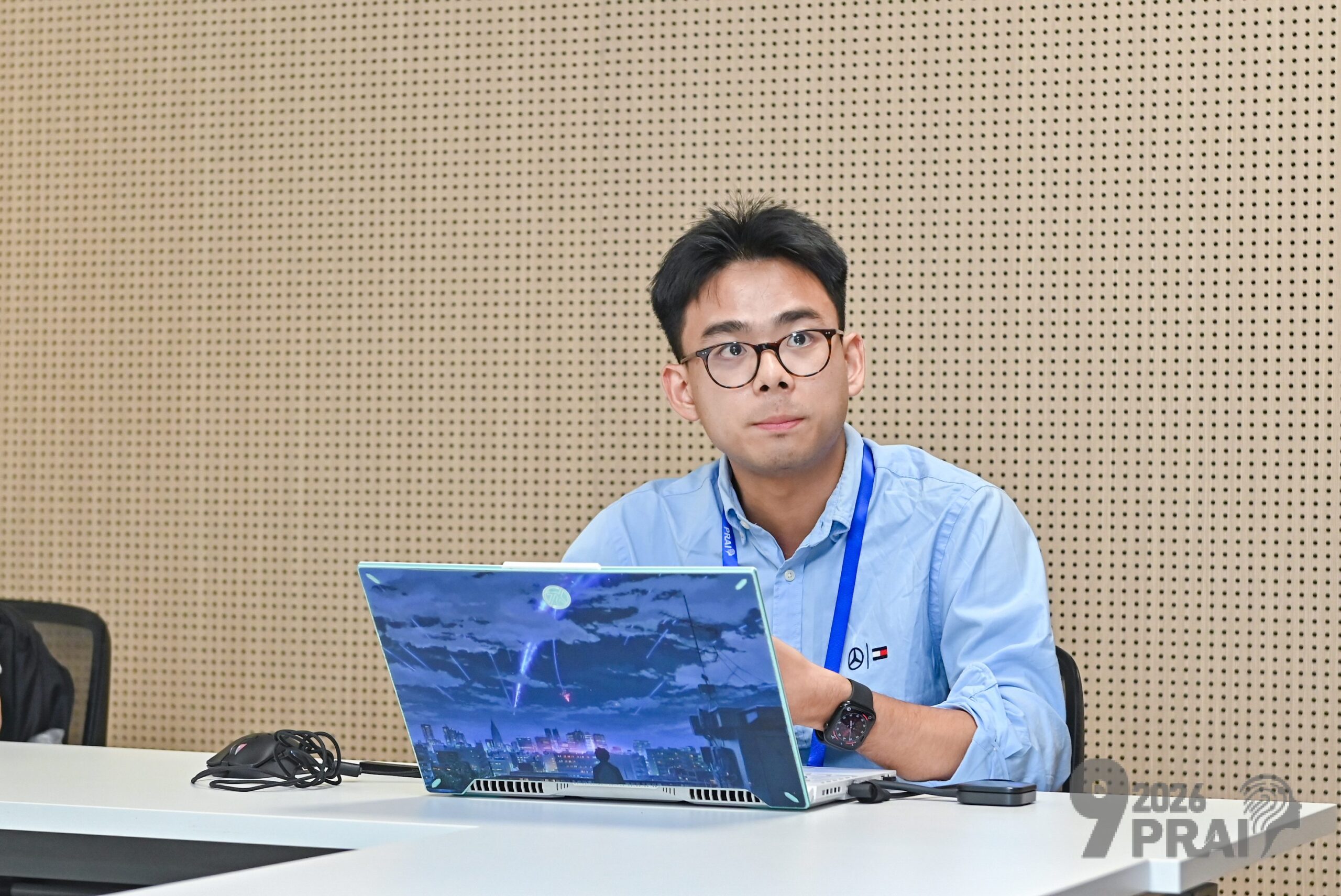
论文概述:
PAPER KEYWORDS
OTP Flooding / Authentication Logs / Behavioral Detection / Robustness
RESEARCH QUESTION
When real-world OTP abuse logs are difficult to make public, can interpretable behavioral features in authentication logs identify plausible OTP flooding risk under a rigorously controlled experimental design?
METHOD DESIGN
Public RBA authentication logs are used as the behavioral background. The data are chronologically split before four controlled OTP-abuse variants are injected separately into training and future holdout periods. Nineteen interpretable temporal, velocity, and diversity features are then evaluated with lightweight models and static-rule baselines.
KEY RESULTS
On the future temporal holdout, Random Forest achieves 90.16% precision, 95.68% recall, 92.84% F1, 97.47% PR-AUC, and a 1.04% false-positive rate. Multi-seed uncertainty, threshold calibration, ablation, adaptive-adversary stress tests, and an external authentication baseline are used to test the stability of the conclusions.
STUDY BOUNDARY
The paper presents evidence of controlled detectability rather than direct proof of production-level OTP-attack accuracy. Recall drops substantially when attackers slow their request rate or imitate legitimate behavior.
RESEARCH HIGHLIGHTS
• The chronological split is performed before attack injection, and independent random seeds are used for training and future-test attacks to reduce leakage risk.
• The evaluation goes beyond a single model score by examining prevalence, ablation, threshold calibration, adaptive-adversary stress, and an external baseline.
• The results show that lightweight models can detect rate-driven abuse under controlled conditions, while low-and-slow and legitimate-mimicking attacks remain important challenges.
安文彻:从写清楚到讲清楚
“站在台上,我才第一次真切意识到:把内容写好,和把它讲明白,根本不是一回事。” ——安文彻
8月14日,我先以听众身份参加开幕式和学术报告。我开始留意的不只是“报告讲了什么”,还包括报告人如何从问题切入、如何在有限时间里筛选重点,以及怎样把复杂研究讲给并未读过论文的听众。
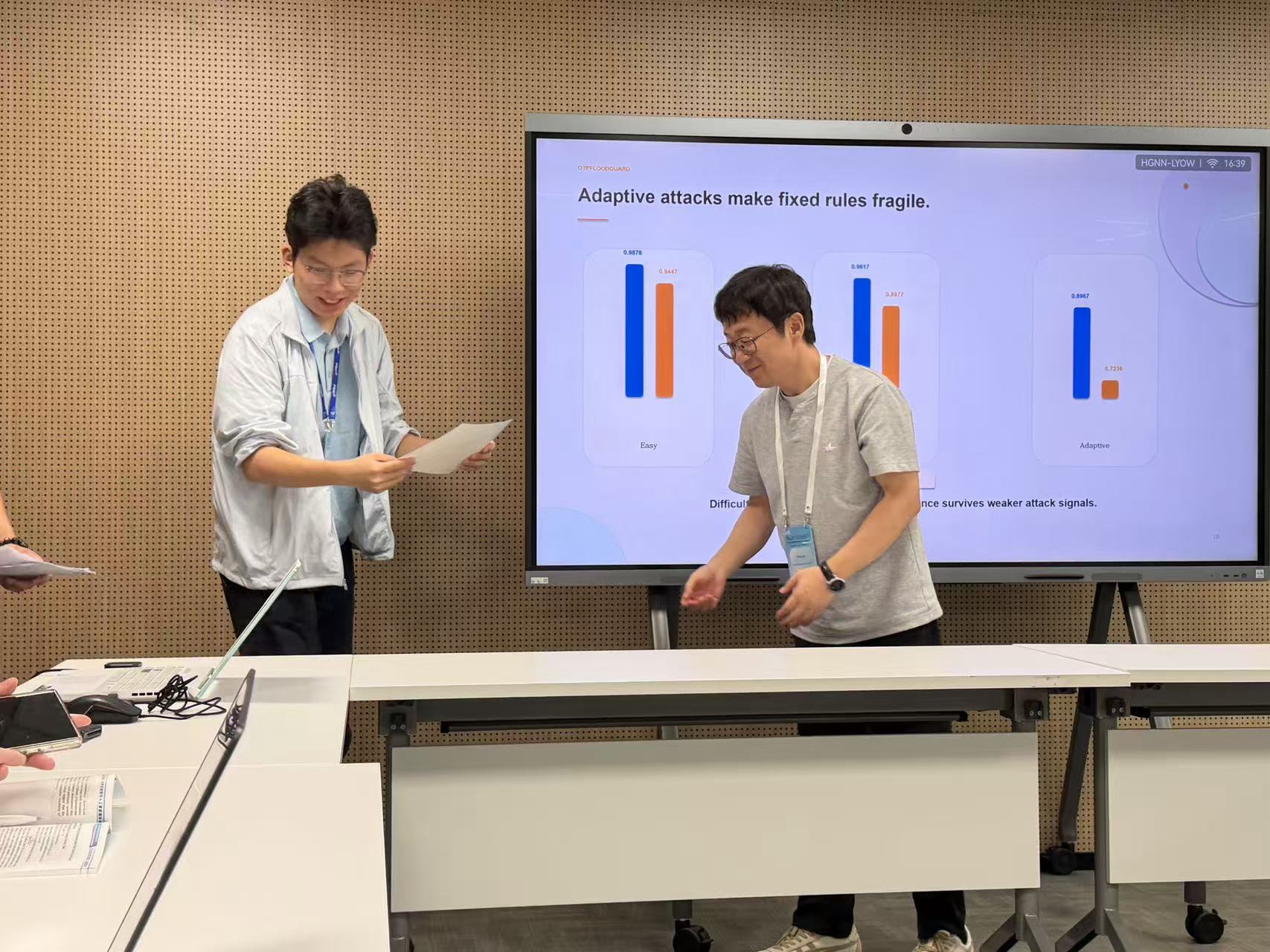
8月15日,当身份从听众切换为报告人后,这种观察变成了切身体验。我在汇报中没有试图复述论文的全部技术细节,而是围绕“为什么要做、做了什么、带来什么价值”组织主线。汇报结束后,我又回到台下继续听其他报告,并开始更加关注PPT组织、过渡方式与核心贡献的表达。对我而言,这次经历最重要的意义,是从“听众—报告人—听众”的转换中理解:科研不仅要做出来、写下来,也要能够让别人真正理解。
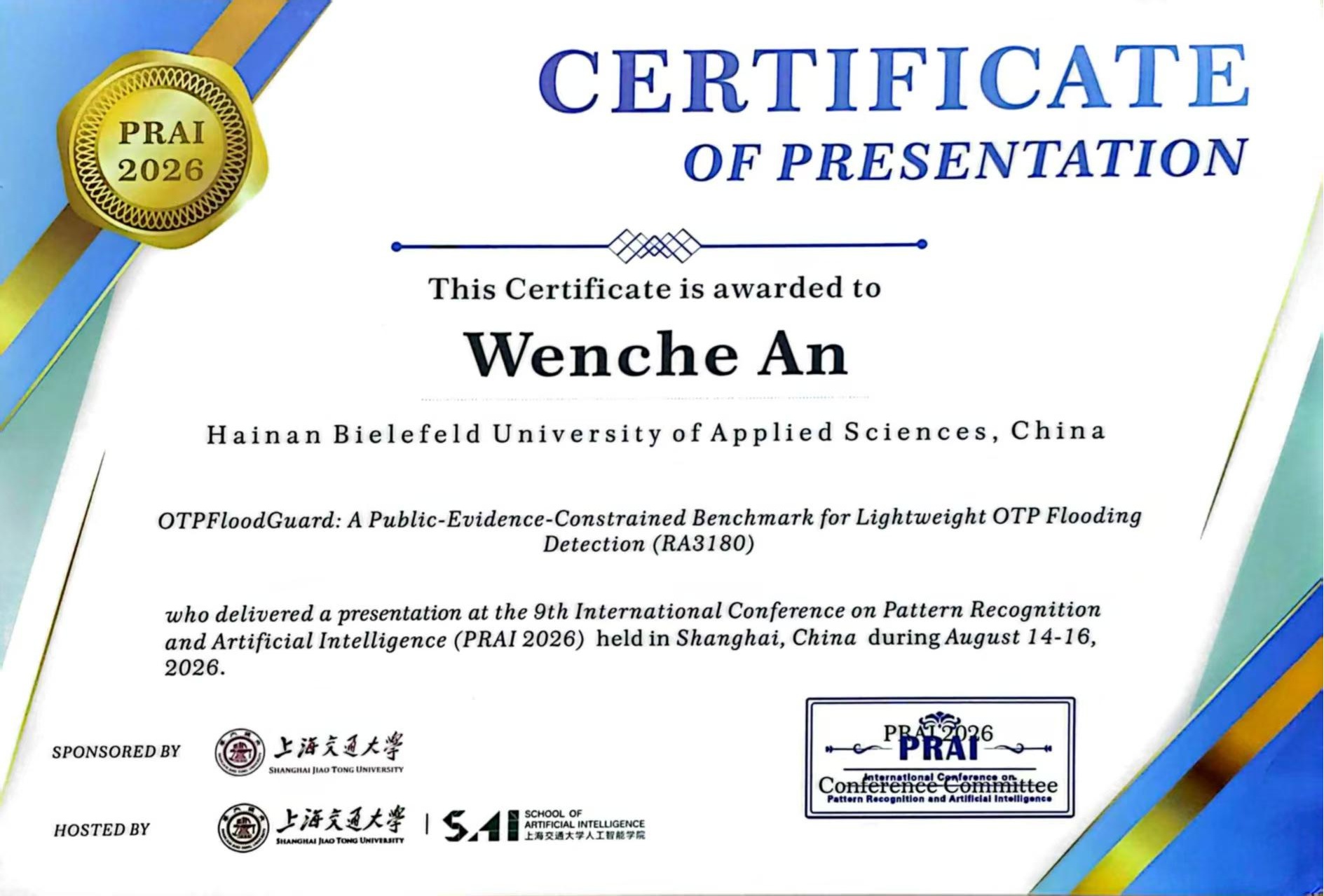
论文概述:
PAPER KEYWORDS
Public Evidence / Benchmark Design / OTP Flooding / Stress Testing
RESEARCH QUESTION
When public, task-matched OTP flooding logs are unavailable, how can researchers build a transparent, inspectable, replaceable, and stress-testable benchmark instead of substituting unrelated public datasets?
METHOD DESIGN
Public OTP/SMS abuse evidence is mapped into explicit threat assumptions, 20 window-level behavioral features, three difficulty regimes (Easy, Overlap, and Adaptive), and a set of diagnostics and robustness checks. The contribution is a benchmark-construction procedure rather than a new classifier.
KEY RESULTS
Random Forest reaches an F1-score of 0.9617 on the main Overlap benchmark, with a seven-seed mean F1 of 0.9514 ± 0.0052. Performance decreases from 0.9876 F1 on Easy to 0.8967 on Adaptive, while generator-shift testing further reduces F1 to 0.8720.
RESEARCH VALUE
By making assumptions, difficulty controls, and failure cases explicit, OTPFloodGuard turns the absence of public real-world OTP logs from a blocking limitation into a benchmark-design problem that can be inspected, replaced, calibrated, and improved.
RESEARCH HIGHLIGHTS
• Easy, Overlap, and Adaptive are designed to test progressively harder overlap and mimicry conditions rather than simply maximize benchmark scores.
• Public evidence is used to support risk signals and threat assumptions, not to claim that simulated distributions equal real production traffic or deployment accuracy.
• Explicit assumptions and open difficulty controls make the benchmark replaceable, calibratable, and reproducible for future research.
史朝鲁:把课堂知识变成研究问题
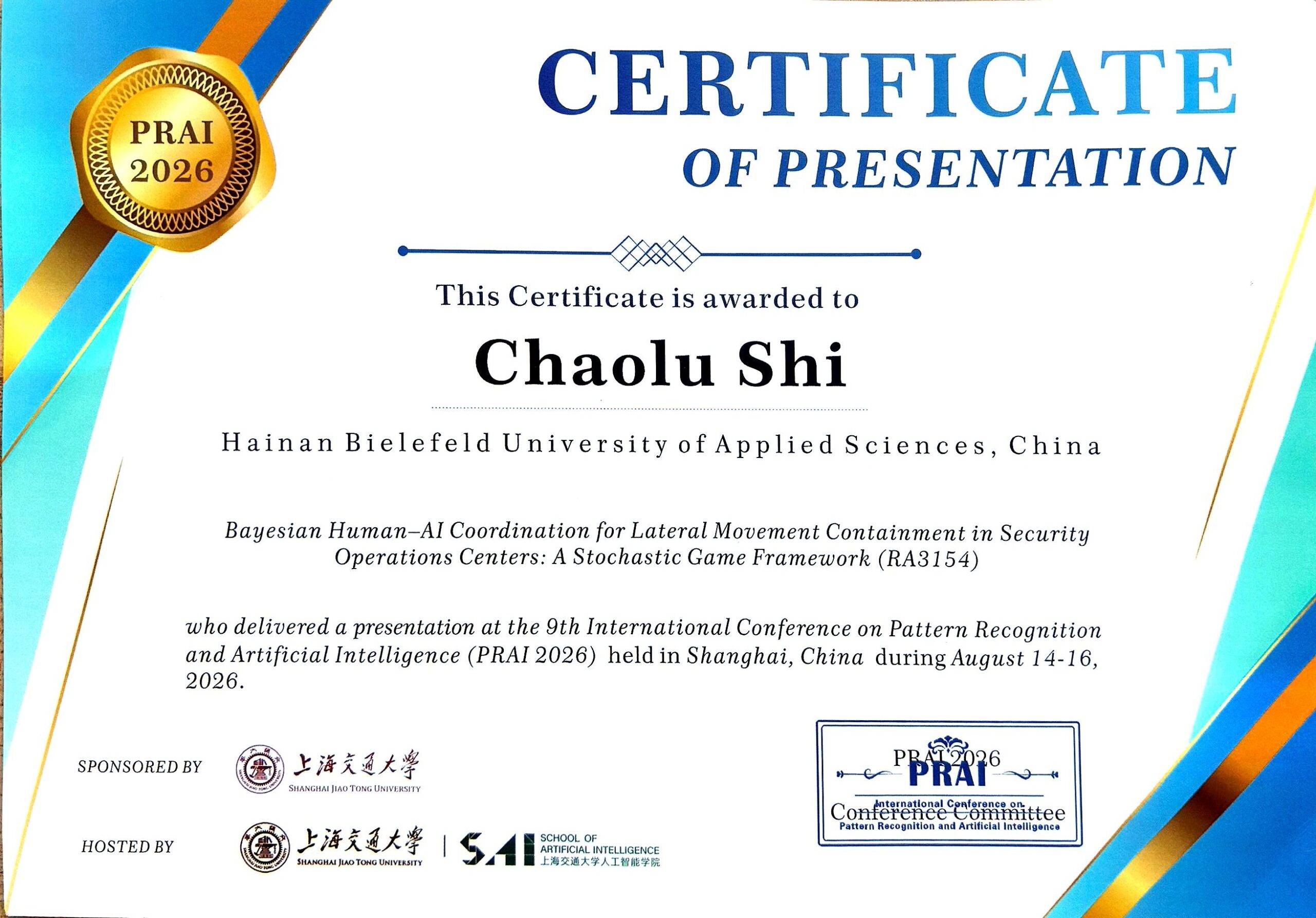
“课堂学习与科研并非两套完全割裂的体系。我们当下所学的诸多内容,未来都有可能成为研究课题的组成部分。”——史朝鲁
我将这次参会形容为一次对“科研学习方式”的重新认识。很多前沿报告虽然与本科课堂看起来有距离,但我逐渐发现,算法、数据处理、模型构建等核心思想其实都能在正在学习的课程中找到基础。不同的是,课堂更强调知识本身,而科研更强调如何用知识提出问题、验证假设并解释结果。
这种现场体验也让我更加关注研究的严谨性:结论是否有充分依据、实验条件是否合理、方法有哪些局限。对我而言,科研能力不只是掌握工具,更重要的是能否对自己的方法保持怀疑,并持续用证据验证。参会之后,我希望将学习从“知识点积累”逐渐转向“问题导向”,加强论文阅读、数据分析与实际项目训练。
论文概述:
PAPER KEYWORDS
Human–AI Coordination / SOC / Stochastic Game / Fog-of-War
RESEARCH QUESTION
In a Security Operations Center, human analysts have global situational awareness but limited intervention capacity, while automated agents act quickly under bounded visibility. How should the two coordinate to contain lateral movement across a network?
METHOD DESIGN
Network assets are modeled as a finite two-player zero-sum stochastic game on a graph. The framework uses a three-phase protocol—global injection, local propagation, and conflict resolution—together with a lightweight belief update. Three interpretable heuristic pairs are compared across five network topologies.
KEY RESULTS
Effectiveness is strongly topology-dependent. On BA scale-free networks, belief-aware frontier expansion with human support-seeding reaches a mean attacker win rate of 29.3%, compared with 23.7% for hub-greedy; on more degree-homogeneous networks, the strategies can become indistinguishable.
KEY FINDING
The belief mechanism matters only when genuine unobserved regions remain. On the spatially extended Grid it adds about +16.7 percentage points. The propagation ratio R = kA/kD is the dominant control parameter, with a critical threshold near R* = 1.5.
RESEARCH HIGHLIGHTS
• The framework turns “human global judgment + AI local execution” into a quantitative graph-game model of coordinated containment.
• The topology-sensitive tournament shows that no single interpretable heuristic dominates across all network structures.
• Ablation results show that belief/fog-of-war reasoning changes behavior only when the observation radius does not already cover the graph.
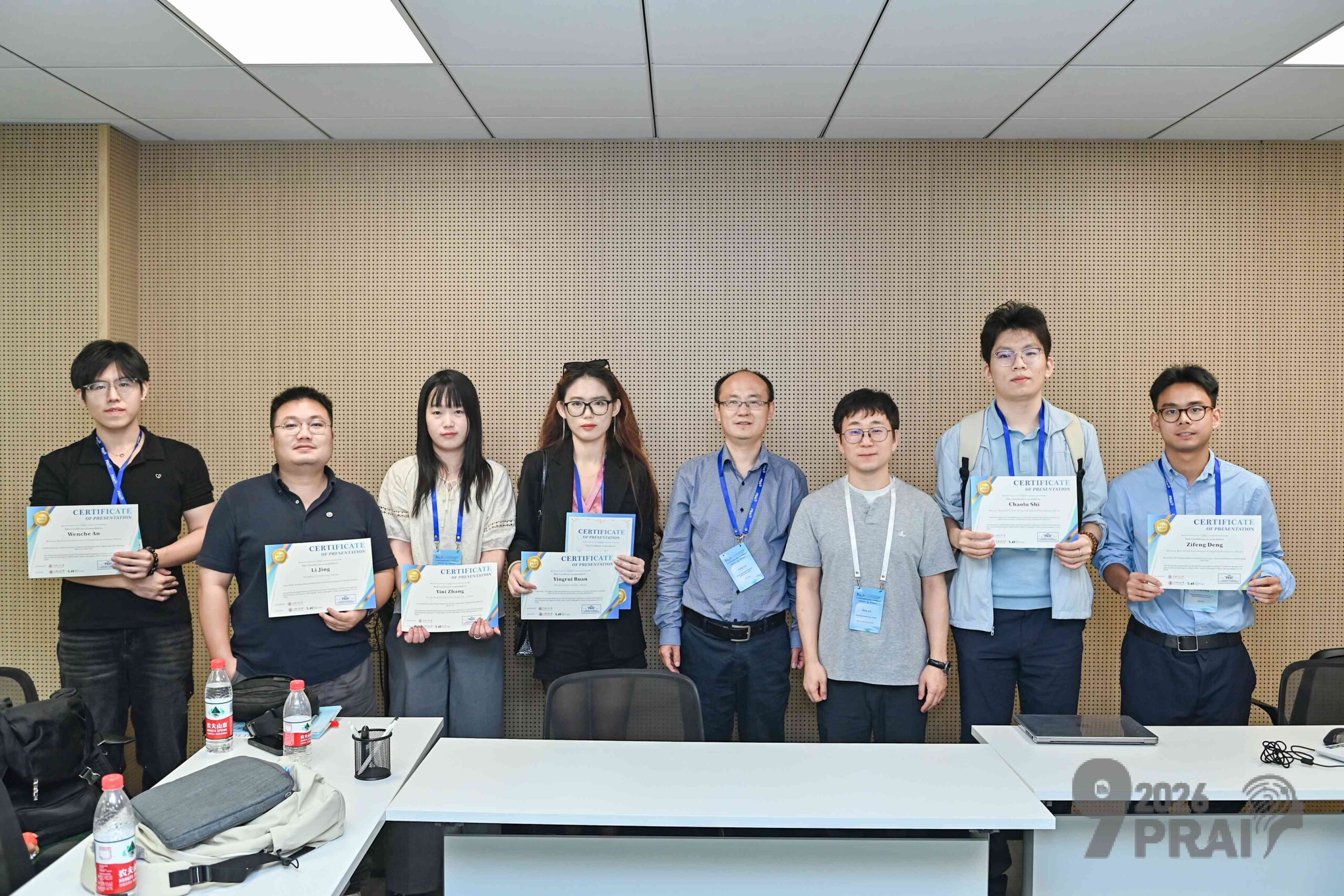
“真正的科研训练,并不只发生在实验室或论文里;当研究进入公开交流场景,问题意识、证据意识与表达能力会同时被检验。”——三位同学的共同总结
三篇论文的主题并不相同,但呈现一个共同的变化:从关注“我会不会这个知识点”,转向关注“为什么这样做、证据够不够、别人能不能理解”。这也是从课程学习走向科研训练的重要一步。
学术会议的价值,不只在于“去过”,更在于回到课堂后如何继续。
对于本科阶段的学生而言,国际会议提供了一种很难被课堂完全替代的学习方式:可以看到一个研究问题如何被提出、如何被设计成实验、如何被写成论文,又如何在十几分钟的现场报告中被重新组织并接受提问。
三位同学的经历表明,科研成长往往不是从“完全准备好”之后才开始,而是在一次次阅读、实验、修改、表达和交流中逐渐形成。
能把课堂里学到的算法、数据处理、模型建构与真实问题连接起来,能在结果不理想时继续验证,能在现场把复杂研究讲清楚,这些过程本身就是研究能力的一部分。
以研相会,向新而行。愿每一次走出课堂的交流,都能带着新的问题、新的证据和新的表达方式回到学习之中。