
In the award list for the 2025 “Higher Education Press Cup” National College Mathematical Contest in Modeling (Hainan Division), announced on September 28th, two student teams from our university stood out, both winning Third Prizes in the undergraduate group. This demonstrates our students’ solid mathematical foundation, interdisciplinary modeling capabilities, and team spirit. It is worth mentioning that this marks another provincial-level achievement for our students, following the excellent results obtained by our university(2024 award-winning students: ZHU Yurun, HE Yi, QIAO Dengfeng)in last year’s competition.
Award List
DENG Zifeng, CHEN Jingtong, LI Haoran (Hainan Division Third Prize)
FU Yuhan, HE Sibo, CHEN Yinuo (Hainan Division Third Prize)
The National College Mathematical Contest in Modeling (CUMCM), organized by the China Society for Industrial and Applied Mathematics, is one of the largest and most influential disciplinary competitions for university students in China. Held annually, participating teams must independently complete the entire process – from modeling and computer implementation to thesis writing – over three consecutive days, addressing practical problems in fields such as science, engineering, economic management, and humanities and social sciences.
The 2025 “Higher Education Press Cup” National College Mathematical Contest in Modeling (Hainan Division) attracted 473 teams from 16 universities. The competition was held from September 4th to September 7th for both undergraduate and vocational college groups. In this intense four-day marathon, our students ultimately secured this honor through close teamwork.
Below, let’s follow the preparation journey of these two teams:
Extreme Sprint with Only Ten Hours of Sleep in Three Days
“Over four days and three nights, we slept less than ten hours in total, but that contest where we all gave it our all ended up being an absolute blast and one of our best college memories.” Recalling the recently concluded contest, student DENG Zifeng said it felt like the team had gone through a tense yet fulfilling long dream: “We chose a problem concerning ‘silicon carbide thickness measurement.’ The whole process felt like leveling up in a game.”
“On day one, we started with the most basic optical interference model, building the theoretical ‘blueprint.’ On day two, we turned the model into a runnable algorithm. Seeing the fitted curve match the data for the first time gave us hope. On day three, strange peaks appeared in the data, and our initial method failed. We decisively switched to a more complex multi-beam model, debugging overnight and optimizing repeatedly.”
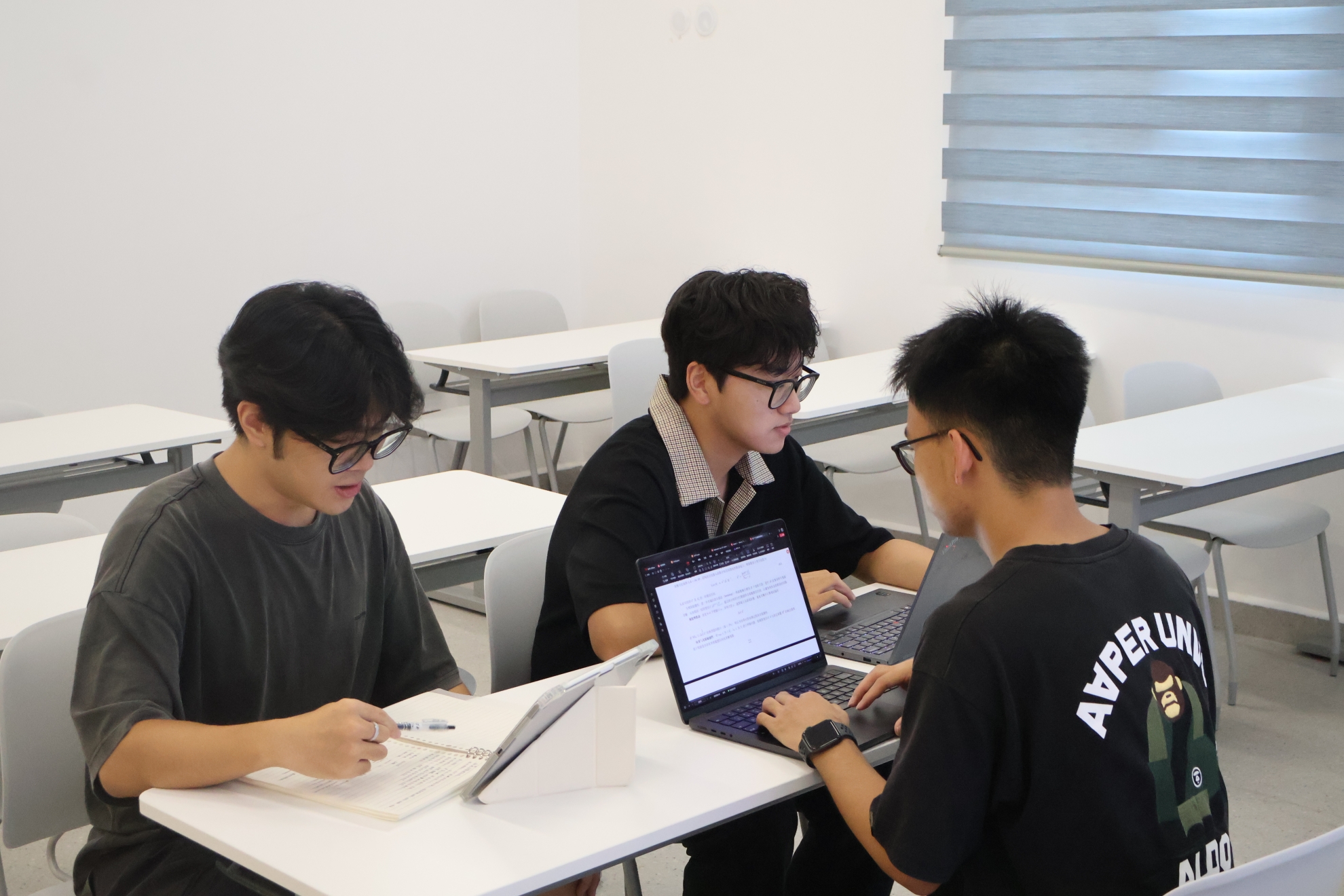
Records of student preparation process
“The most exciting moment was at the very end when the curve from our new model almost perfectly overlapped with the experimental data – we nearly shouted out loud in the lab. At that moment, all the fatigue felt worth it. From theory to practice, from algorithm to generating plots, from an R_score of just a few hundredths to several tenths, we challenged ourselves again and again.
These four days taught us not only how to translate complex physical problems into mathematics and code but also the power of teamwork. The late-night brainstorming sessions, repeated debugging and corrections, the cheers when the results converged… These moments are more memorable than the final answer itself. Although the results are out and might not have met our highest expectations, as the saying goes, all regrets pave the way for the future! We will carry this experience with us and continue exploring possibilities.” (DENG Zifeng, CHEN Jingtong, LI Haoran)
Three-Night-and-Four-Day Modeling Marathon
“The four-day competition felt more like a real-world ‘drill’ in teamwork. We deeply realized: there is no perfect individual, only a perfect team. When facing challenges like ‘difficulties deriving multi-beam interference conditions’ or ‘TMM fitting convergence issues,’ we always sat together, drawing, discussing, and trial-and-error testing. Often, inspiration from one idea could make the whole team see the light.” Team members FU Yuhan, HE Sibo, and CHEN Yinuo reflected on the preparation process, stating: “The focus of our teammates, the joy of solving a difficult problem, the relief after submitting the paper… These moments made us understand that while the competition result is important, what is even more precious is the rapport built during the process, the problem-solving skills honed, and the perseverance shown under pressure.”
Once again, congratulations to all the award-winning students! May you continue to maintain your passion for exploration and courage to tackle challenges, going further and achieving more success on your future paths in scientific research and innovation!