

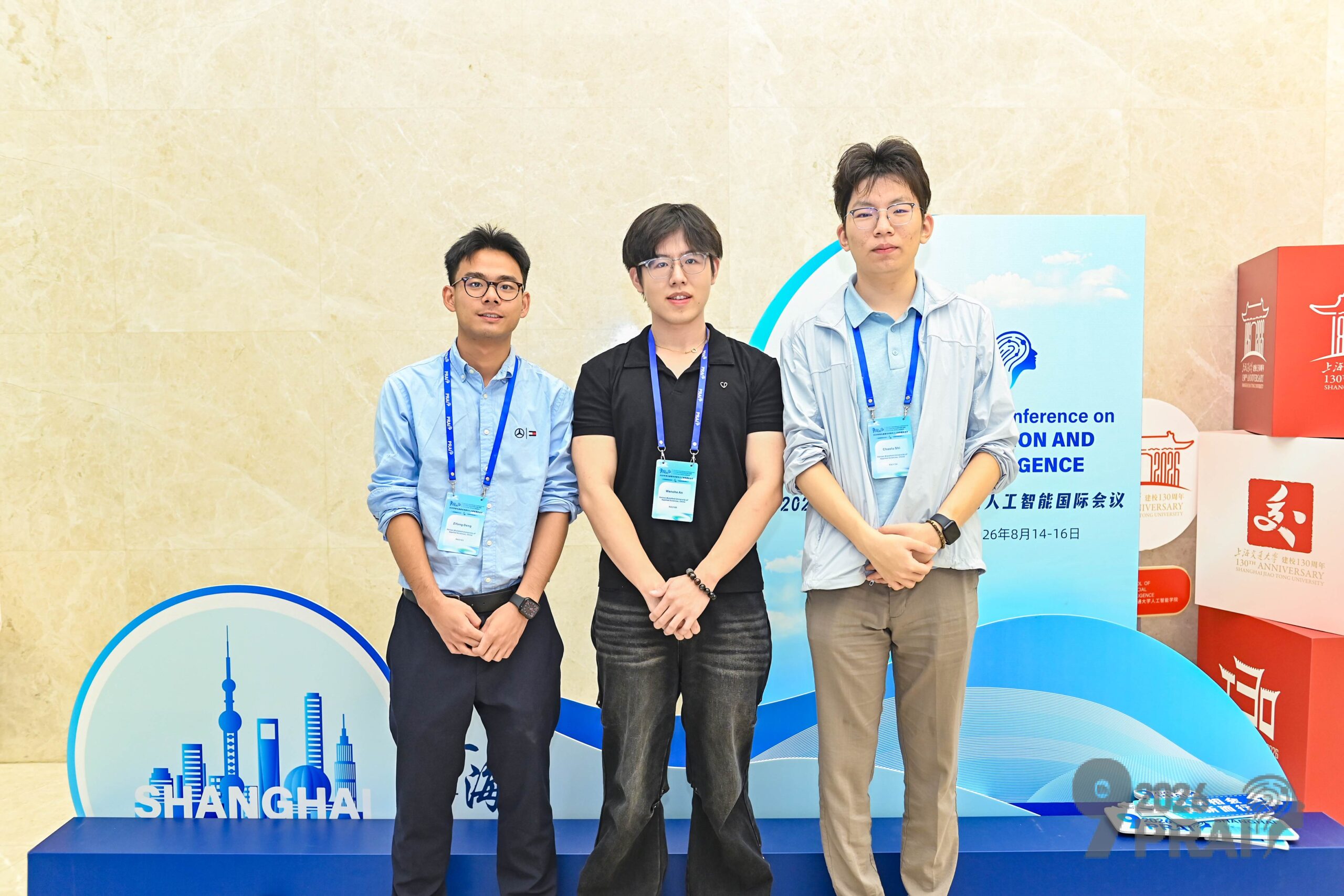
From August 14 to 16, 2026, the 9th International Conference on Pattern Recognition and Artificial Intelligence (PRAI 2026) was held in Shanghai. Three students from our university, DENG Zifeng, AN Wenche and SHI Chaolu, attended the conference with their papers and delivered academic presentations. Three papers, three presentations and three personal insights into research growth record their step from classroom learning to the international academic arena.
DENG Zifeng: Defining the Boundary of Detectability in Controlled Experiments
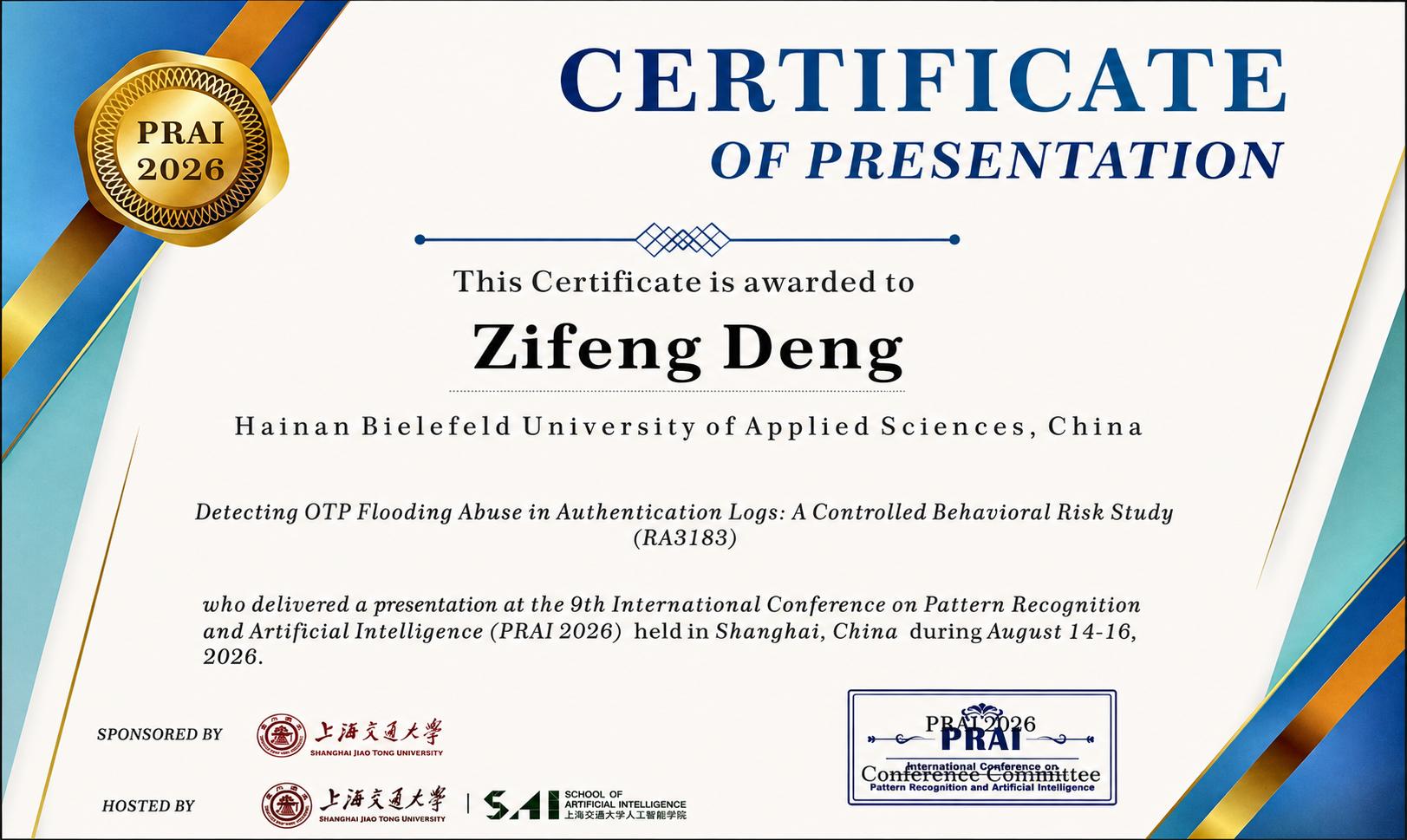
“Research communication focuses on sharing ideas, discussing problems, and gaining new knowledge from diverse perspectives.” — DENG Zifeng
Before attending PRAI 2026, I had been engaged in research for nearly a year. Through reading papers, testing methods, troubleshooting experiments, and repeatedly rerunning analyses, I gradually came to see that research rarely depends on a single sudden “good idea.” More often, it is the patient process of solving small problems, checking evidence, and improving the work step by step. Talking with people on site made this understanding more concrete.
I spoke with master’s students, doctoral students, and researchers working on topics such as market prediction, lightweight YOLO models, and robotics. These discussions also sparked ideas for my other research interests.
For me, the most valuable outcome was not simply completing a presentation, but realizing that the quiet hours I had spent reading, debugging, and accumulating experience had gradually become genuine research experience that I could now discuss with others.
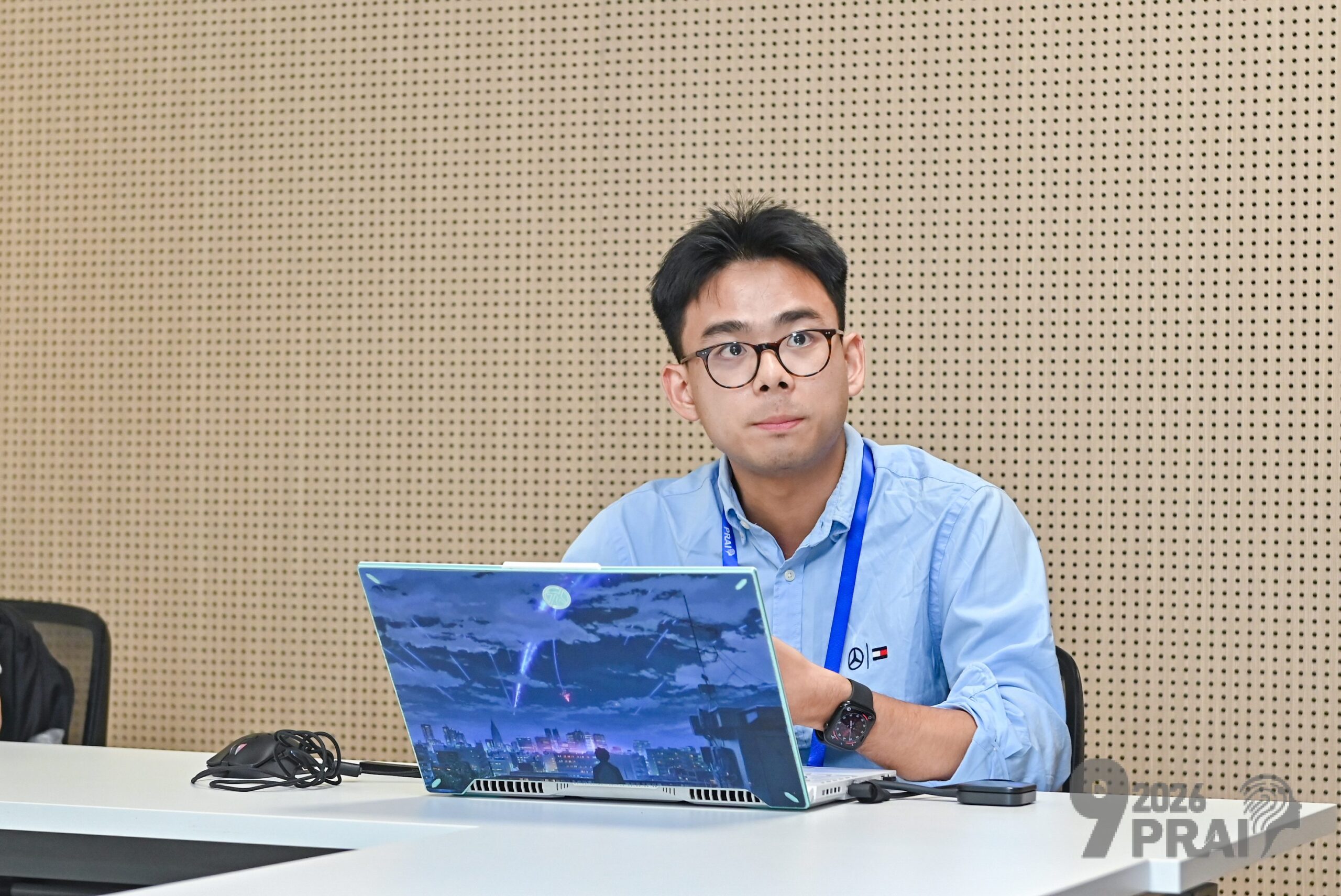
PAPER OVERVIEW
PAPER KEYWORDS
OTP Flooding / Authentication Logs / Behavioral Detection / Robustness
RESEARCH QUESTION
When real-world OTP abuse logs are difficult to make public, can interpretable behavioral features in authentication logs identify plausible OTP flooding risk under a rigorously controlled experimental design?
METHOD DESIGN
Public RBA authentication logs are used as the behavioral background. The data are chronologically split before four controlled OTP-abuse variants are injected separately into training and future holdout periods. Nineteen interpretable temporal, velocity, and diversity features are then evaluated with lightweight models and static-rule baselines.
KEY RESULTS
On the future temporal holdout, Random Forest achieves 90.16% precision, 95.68% recall, 92.84% F1, 97.47% PR-AUC, and a 1.04% false-positive rate. Multi-seed uncertainty, threshold calibration, ablation, adaptive-adversary stress tests, and an external authentication baseline are used to test the stability of the conclusions.
STUDY BOUNDARY
The paper presents evidence of controlled detectability rather than direct proof of production-level OTP-attack accuracy. Recall drops substantially when attackers slow their request rate or imitate legitimate behavior.
RESEARCH HIGHLIGHTS
• The chronological split is performed before attack injection, and independent random seeds are used for training and future-test attacks to reduce leakage risk.
• The evaluation goes beyond a single model score by examining prevalence, ablation, threshold calibration, adaptive-adversary stress, and an external baseline.
• The results show that lightweight models can detect rate-driven abuse under controlled conditions, while low-and-slow and legitimate-mimicking attacks remain important challenges.
AN Wenche: From Writing Clearly to Presenting Clearly
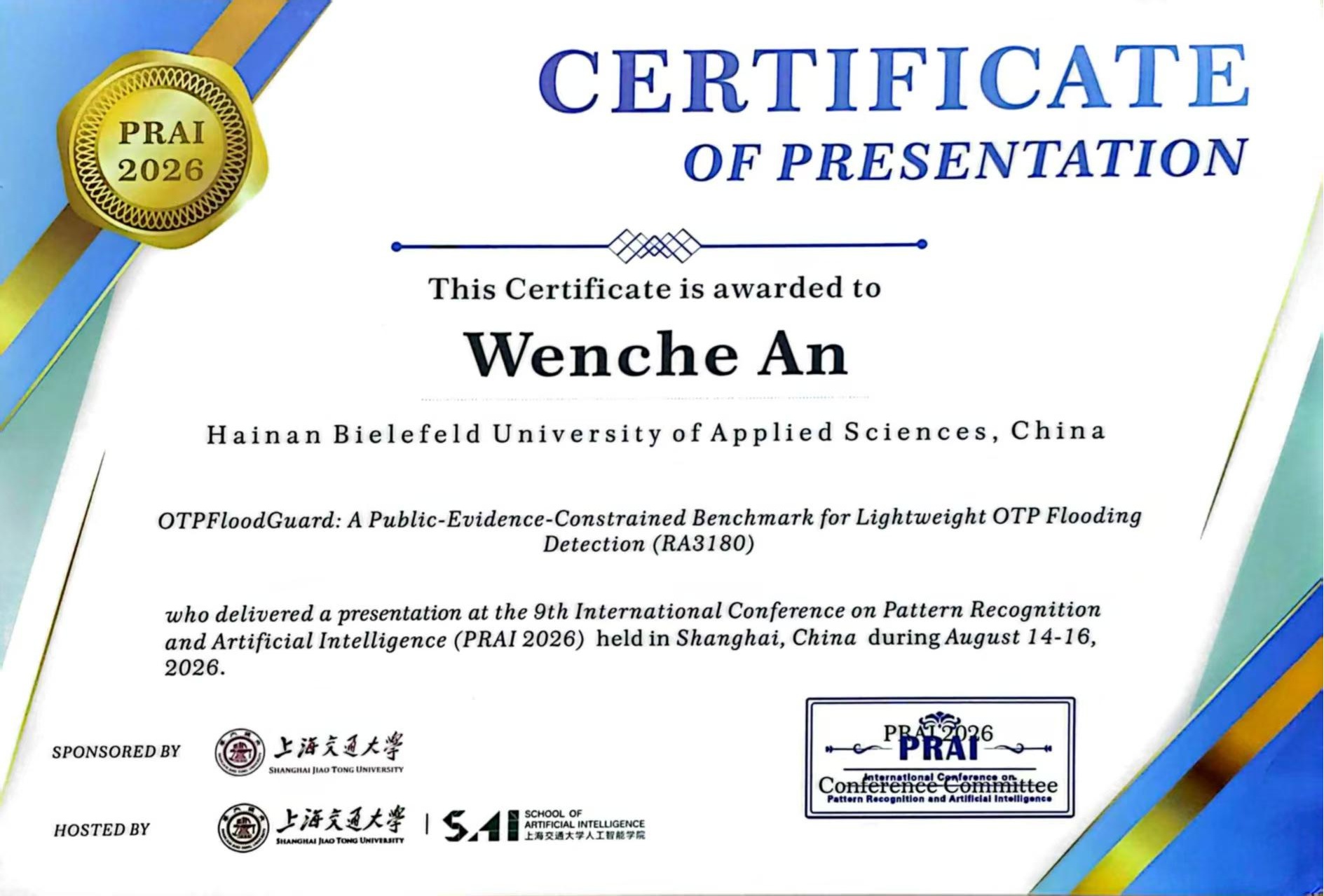
“Standing on the stage made me realize clearly for the first time that writing something well and explaining it well are not the same thing.” — AN Wenche
On August 14, I first attended the opening ceremony and academic talks as an audience member. I began to pay attention not only to what each speaker presented, but also to how they approached the research question, how they selected key points within a limited time, and how they made complex research understandable to listeners who had not read the paper in advance.
On August 15, when my role shifted from audience member to presenter, those observations became firsthand experience. In my presentation, I did not try to reproduce every technical detail of the paper. Instead, I organized the main thread around three questions: why the work was done, what was done, and what value it brings. After presenting, I returned to the audience and continued listening to other talks, paying closer attention to slide organization, transitions, and how core contributions were expressed. For me, the most important meaning of this experience lies in what I understood through the shift from audience member to presenter and back again: research must not only be carried out and written down, but also communicated in a way that others can truly understand.
PAPER OVERVIEW
PAPER KEYWORDS
Public Evidence / Benchmark Design / OTP Flooding / Stress Testing
RESEARCH QUESTION
When public, task-matched OTP flooding logs are unavailable, how can researchers build a transparent, inspectable, replaceable, and stress-testable benchmark instead of substituting unrelated public datasets?
METHOD DESIGN
Public OTP/SMS abuse evidence is mapped into explicit threat assumptions, 20 window-level behavioral features, three difficulty regimes (Easy, Overlap, and Adaptive), and a set of diagnostics and robustness checks. The contribution is a benchmark-construction procedure rather than a new classifier.
KEY RESULTS
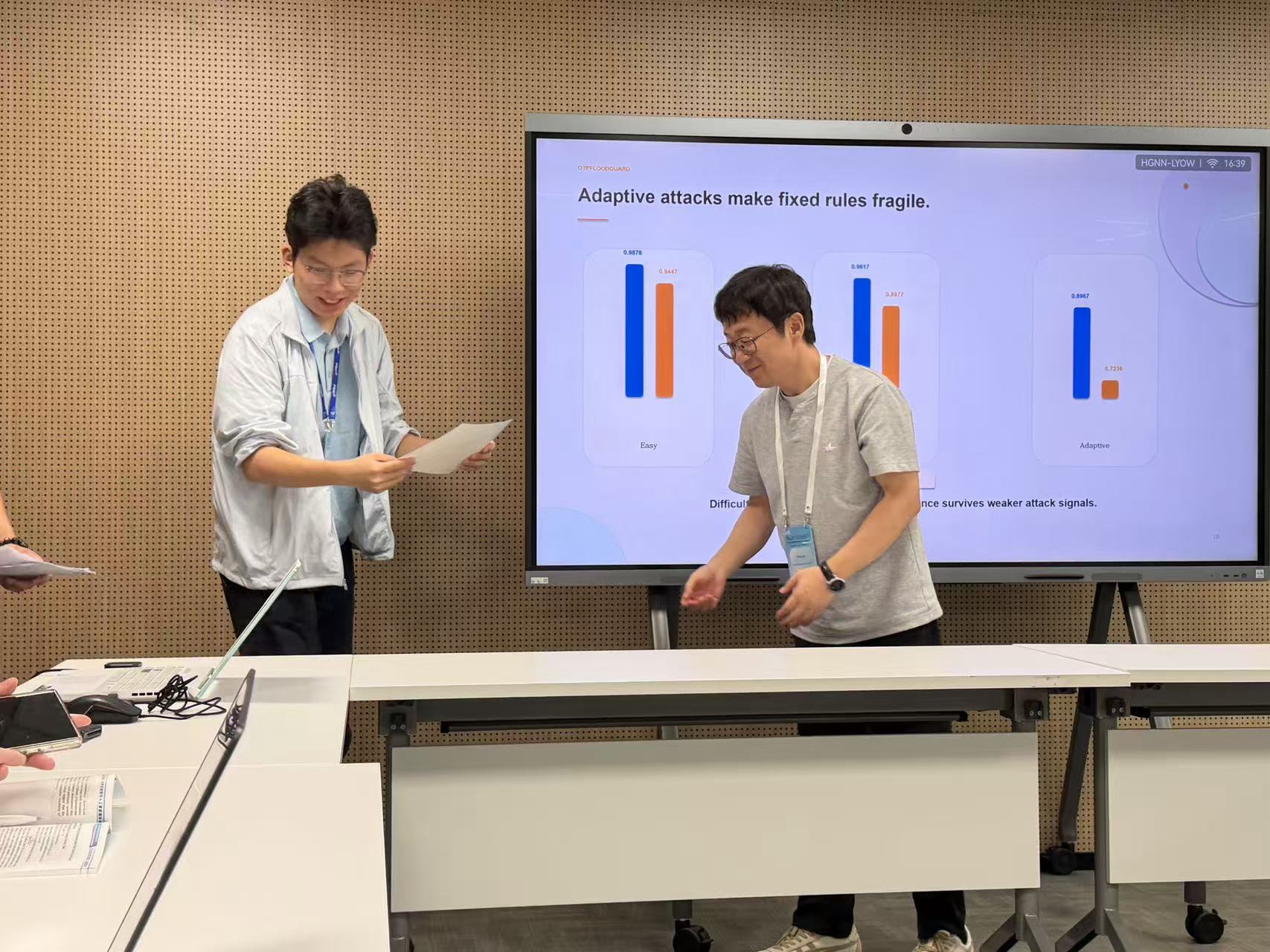
Random Forest reaches an F1-score of 0.9617 on the main Overlap benchmark, with a seven-seed mean F1 of 0.9514 ± 0.0052. Performance decreases from 0.9876 F1 on Easy to 0.8967 on Adaptive, while generator-shift testing further reduces F1 to 0.8720.
RESEARCH VALUE
By making assumptions, difficulty controls, and failure cases explicit, OTPFloodGuard turns the absence of public real-world OTP logs from a blocking limitation into a benchmark-design problem that can be inspected, replaced, calibrated, and improved.
RESEARCH HIGHLIGHTS
• Easy, Overlap, and Adaptive are designed to test progressively harder overlap and mimicry conditions rather than simply maximize benchmark scores.
• Public evidence is used to support risk signals and threat assumptions, not to claim that simulated distributions equal real production traffic or deployment accuracy.
• Explicit assumptions and open difficulty controls make the benchmark replaceable, calibratable, and reproducible for future research.
SHI Chaolu: Turning Classroom Knowledge into Research Questions
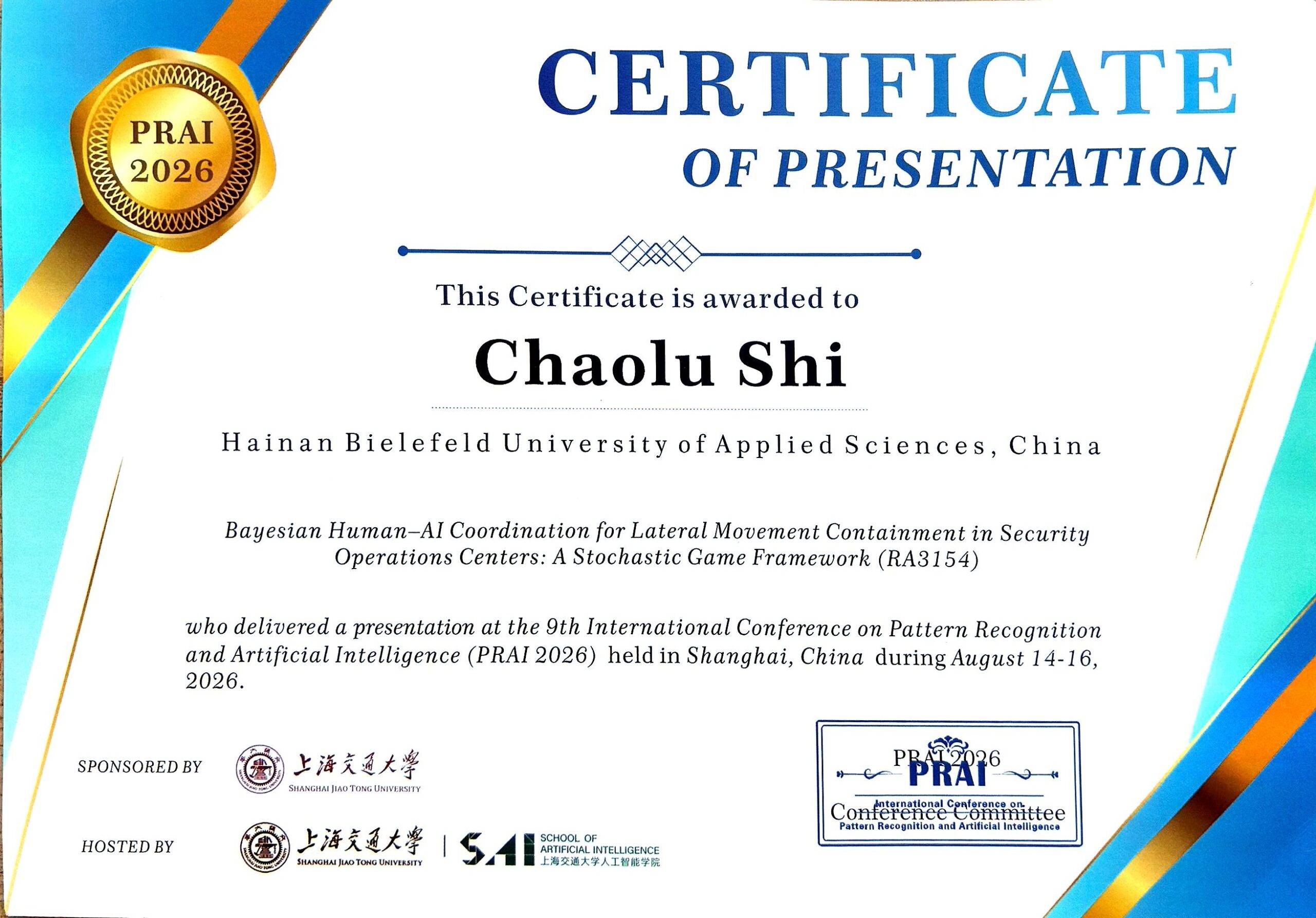
“Classroom learning and research are not two completely separate systems. Much of what we learn today may become part of a research question in the future.” — SHI Chaolu
I would describe this conference as an opportunity to rethink how research is learned. Although many frontier talks initially seemed far removed from undergraduate coursework, I gradually recognized that their foundations—algorithms, data processing, and model construction—could actually be found in the courses I was taking. The difference is that coursework emphasizes knowledge itself, while research emphasizes how to use knowledge to formulate questions, test hypotheses, and interpret results.
This firsthand experience also made me more attentive to research rigor: whether conclusions are sufficiently supported, whether experimental conditions are reasonable, and what limitations a method may have. For me, research ability is not just about mastering tools; more importantly, it is about whether I can remain skeptical of my own methods and continuously validate them with evidence. After the conference, I hope to gradually shift my learning from “accumulating knowledge points” to “problem-oriented” learning, and to strengthen my practice in paper reading, data analysis, and practical project work.
PAPER OVERVIEW
PAPER KEYWORDS
Human–AI Coordination / SOC / Stochastic Game / Fog-of-War
RESEARCH QUESTION
In a Security Operations Center, human analysts have global situational awareness but limited intervention capacity, while automated agents act quickly under bounded visibility. How should the two coordinate to contain lateral movement across a network?
METHOD DESIGN
Network assets are modeled as a finite two-player zero-sum stochastic game on a graph. The framework uses a three-phase protocol—global injection, local propagation, and conflict resolution—together with a lightweight belief update. Three interpretable heuristic pairs are compared across five network topologies.
KEY RESULTS
Effectiveness is strongly topology-dependent. On BA scale-free networks, belief-aware frontier expansion with human support-seeding reaches a mean attacker win rate of 29.3%, compared with 23.7% for hub-greedy; on more degree-homogeneous networks, the strategies can become indistinguishable.
KEY FINDING
The belief mechanism matters only when genuine unobserved regions remain. On the spatially extended Grid it adds about +16.7 percentage points. The propagation ratio R = kA/kD is the dominant control parameter, with a critical threshold near R* = 1.5.
RESEARCH HIGHLIGHTS
• The framework turns “human global judgment + AI local execution” into a quantitative graph-game model of coordinated containment.
• The topology-sensitive tournament shows that no single interpretable heuristic dominates across all network structures.
• Ablation results show that belief/fog-of-war reasoning changes behavior only when the observation radius does not already cover the graph.
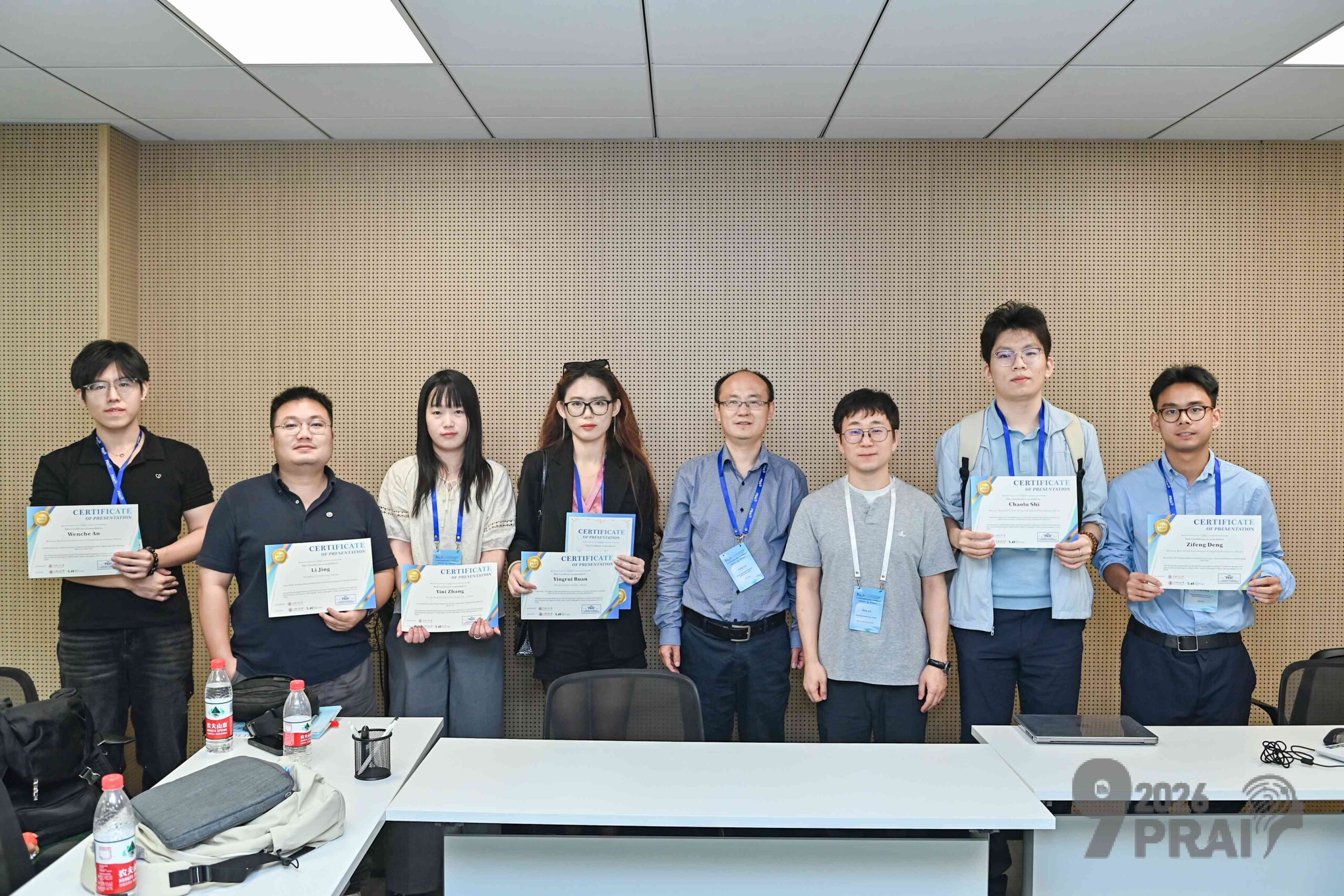
“Research training does not take place only in laboratories or papers. Once research enters a public academic setting, problem awareness, evidence awareness, and communication skills are tested at the same time.” — A Joint Summary by the Three Students
The three papers address different topics, but show a common shift in mindset: from asking “Do I know this concept?” to asking “Why is this approach appropriate, is the evidence sufficient, and can other people understand the reasoning?” This shift marks an important step from classroom learning toward genuine research training.
The value of an academic conference lies not only in attending it, but in how we continue after returning to the classroom.
For undergraduate students, an international conference offers a form of learning that is difficult to reproduce fully in the classroom. It provides a direct view of how a research question is formulated, translated into an experimental design, developed into a paper, and then reorganized into a ten-odd-minute live presentation that must withstand questions from an audience.
The experiences of the three students show that research growth does not begin only after someone feels “fully prepared.” It develops gradually through repeated cycles of reading, experimenting, revising, presenting, and discussing.
Connecting classroom concepts in algorithms, data processing, and modeling with real research problems, continuing to validate ideas when results are imperfect, and explaining complex work clearly in front of an audience are all part of becoming a stronger researcher.
Meeting through Research, Moving toward the New. May every academic exchange beyond the classroom bring new questions, stronger evidence, and better ways of communicating back into the learning process.