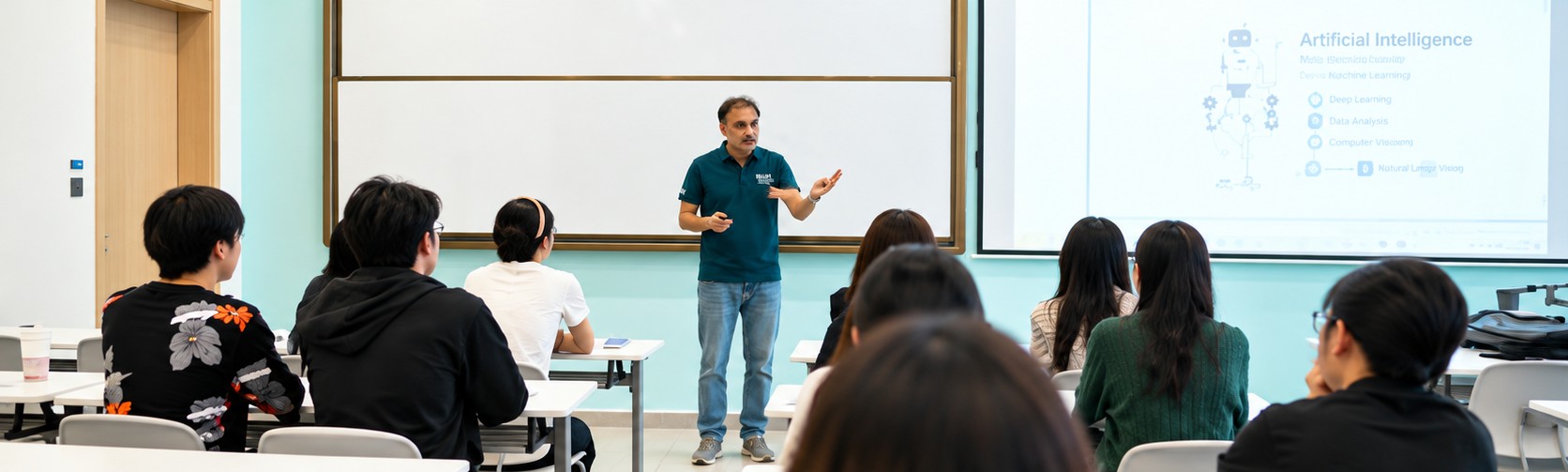
Dr. Ahmad Ali, Lecturer in Computer Science at Hainan Bielefeld University of Applied Sciences (BiUH), has been included in the 2026 Stanford/Elsevier World’s Top 2% Scientists list. In response to this recognition, he looks back on a research journey that began with his studies at Shanghai Jiao Tong University, continued through postdoctoral research at Shenzhen University, and led him to BiUH. He shares his understanding of intelligent transportation, spatio-temporal data mining, edge computing and artificial intelligence, together with his reflections on perseverance, curiosity, research integrity and the mission of teaching. The recognition, he says, is not a destination, but a new starting point — a fresh beginning for continuing research that is reliable, useful and responsible.
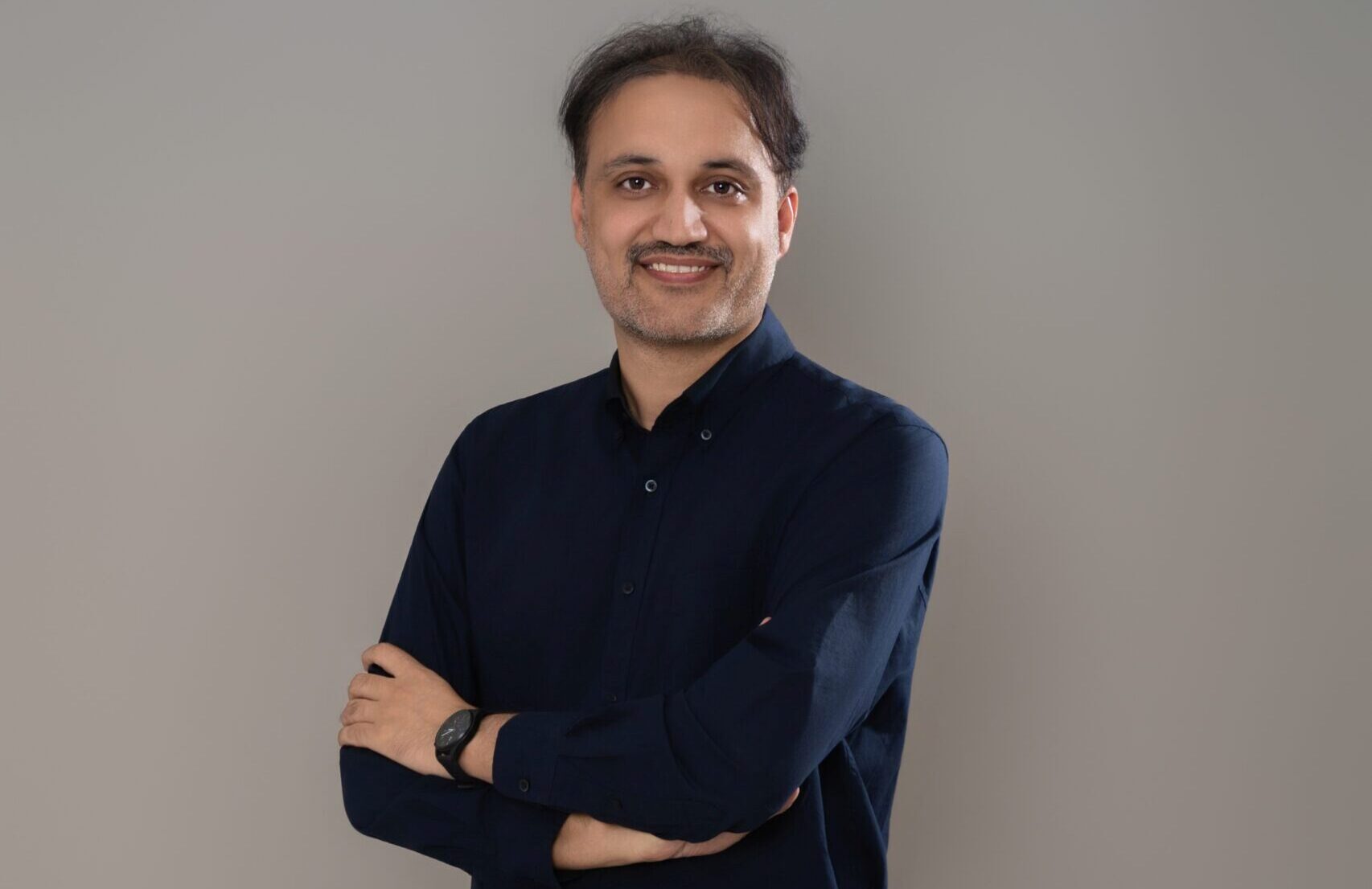
Dr. Ahmad Ali has extensive experience in research, teaching, and academic service. He earned his Ph.D. in Computer Science and Technology from Shanghai Jiao Tong University and has served as a lecturer and visiting lecturer at several universities, teaching courses in artificial intelligence, data analytics & machine learning, cloud computing & IoT, and programming. He has received several prestigious honors, including the Shanghai Municipal Government Category A Ph.D. Scholarship, the Shanghai Jiao Tong University Excellent Master’s Scholarship, and the Shenzhen University Outstanding Postdoctoral Researcher Award (Lixin Award). In 2026, he was also recognized among the World’s Top 2% Scientists in the Stanford University/Elsevier ranking.
Dr. Ali actively contributes to the international academic community through editorial and professional service. He serves as a reviewer for leading international journals and as a technical/program committee member for international conferences, including ICPADS 2025 and ICIC 2026 (CCF C). He has also served as Guest Editor for MDPI journals including Electronics and Algorithms, and holds an editorial role with Artificial Intelligence and Autonomous Systems.
His research has been published in well-recognized journals including Information Sciences, Neural Networks, IEEE Transactions on Intelligent Transportation Systems, IEEE Transactions on Consumer Electronics, Computer Science Review, and Future Generation Computer Systems. His research interests include intelligent transportation systems, artificial intelligence, machine learning, spatio-temporal data mining, big data analytics, and edge-cloud computing.
A Moment That Made Me Look Back
When I learned that I had been included in the 2026 Stanford/Elsevier World’s Top 2% Scientists list, I felt a mixture of joy, gratitude, and quiet disbelief. For a moment, my thoughts were not on rankings or citations. They returned to the ordinary days that made this achievement possible: long hours of study, research questions without immediate answers, experiments that needed to be repeated, and the encouragement of people who believed in my progress.
A scientific achievement can be announced in a single sentence. The journey behind it cannot. It contains uncertainty, patience, mistakes, and small discoveries that gradually become meaningful work. That is why this recognition matters to me. It is not a finish line, but a reminder that persistence and curiosity can carry our ideas further than we initially imagine.
As a faculty member at Hainan Bielefeld University of Applied Sciences (BiUH), I am especially happy to share this moment with my colleagues and students. I hope it encourages someone who is still at the beginning of their journey, wondering whether their efforts will ever make a difference.
Why the Top 2% Scientists Recognition Matters?
The Stanford/Elsevier database is a widely referenced assessment of scientific citation influence developed by researchers associated with Stanford University using Elsevier’s Scopus data. It examines scientists across 20 broad fields and 174 subfields, using a composite of indicators such as citations, the h-index, and measures that account for authorship contributions. Researchers qualify through a high global composite-score ranking or by reaching the top 2% within their subfield. Career-long and single-year impact are reported separately.
Its significance lies in the way research becomes part of a worldwide scientific conversation. A published study has value beyond its pages when other researchers examine its methods, test its ideas, and build on its findings. To know that my work has attracted attention within this international community is deeply encouraging.
Yet scientific influence is larger than any metric. Citation indicators cannot fully measure good teaching, ethical research, collaboration, or the practical benefits of an innovation. I regard this distinction as meaningful evidence of scholarly visibility, not as a complete judgment of a scientist’s worth. It motivates me to produce research that is not only cited, but also reliable, useful, and responsible.
The Questions That Drive My Research
My work focuses on Intelligent Transportation Systems, Traffic Flow Prediction, Spatio-Temporal Data Mining, Edge Computing, Artificial Intelligence, and Machine Learning. These topics may sound technical, but the problems motivating them are familiar to everyone.
Imagine leaving home for an important appointment, only to discover that a short journey will take twice as long because of unexpected congestion. Multiply that experience across a city and the consequences become substantial: wasted hours, increased fuel consumption, environmental pressures, and disruption to daily life.
This leads to a question at the heart of my research: can we understand how traffic changes well enough to anticipate congestion before it becomes severe?
Using machine learning, we investigate how patterns in historical traffic data can help estimate future traffic conditions. The challenge is that roads do not function independently. Traffic at one location may affect neighboring areas, and the same road may behave differently during morning commutes, weekends, or adverse weather. Spatio-temporal modeling helps capture both where these patterns occur and how they evolve over time.
I am also interested in edge computing, which processes information closer to its source, such as roadside devices and connected infrastructure. Combined with intelligent prediction, this approach may support faster decisions without depending entirely on distant computing systems.
The goal is not simply to build an algorithm with impressive accuracy. A useful system must also be robust, computationally efficient, and dependable under changing conditions. For me, artificial intelligence becomes truly valuable when advances in computation are connected to real human needs.
The Work Behind the Results
People often see the completed research paper, not the many uncertain steps that precede it. An idea that looks convincing on paper may fail in an experiment. A model may perform well on one dataset but struggle when conditions change. A reviewer may identify a weakness that requires weeks of additional work.
Such experiences can be discouraging. Over time, however, they have taught me to separate a disappointing result from a failed research journey. Sometimes the most useful discovery is understanding why an approach does not work. That understanding may lead to a better question, a stronger method, or a more honest conclusion.
Artificial intelligence research especially demands this kind of discipline. Improving a performance score is not enough if the result cannot be reproduced or the model is too complex to be used in practice. Good science requires us to question our own findings, acknowledge limitations, and keep improving our methods.
I have learned that perseverance is not simply working longer. It is being willing to reconsider an assumption, listen to criticism, and begin again with greater understanding. The difficult days are not separate from scientific progress; they are often where progress begins.
The People and Places That Shaped Me
My academic journey took important shape at Shanghai Jiao Tong University, China, where I completed my Master’s and PhD studies. Those years strengthened my foundation in computer science and research while teaching me something more enduring: education is not only about learning existing answers, but about acquiring the courage and discipline to ask new questions.
My postdoctoral research experience at Shenzhen University provided another important stage of growth. It challenged me to develop greater independence, refine my scientific judgment, and consider how research contributions fit into a broader field of knowledge.
I am grateful to the supervisors, mentors, colleagues, and collaborators who guided me throughout these stages. Research may be recognized under an individual’s name, but ideas improve through discussions, constructive disagreement, shared expertise, and encouragement. No achievement of this kind belongs to one person alone.
Joining BiUH has given my journey a new purpose. Its international academic environment and applied-sciences orientation connect closely with my belief that scientific knowledge should engage with real engineering and societal challenges. Here, I hope to contribute not only through research, but through the opportunities I help create for students.
What I Hope to Give My Students
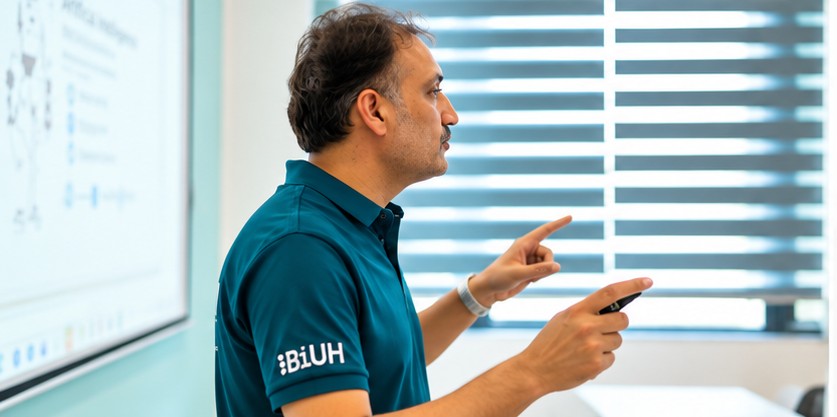
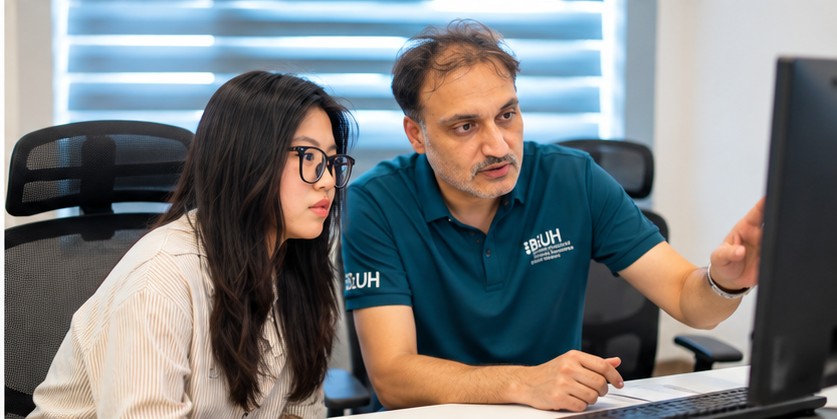
One of the greatest privileges of academic life is watching students gain confidence in their abilities. A student who initially finds programming difficult may later build a working model. Someone who hesitates to ask a question may discover that the question leads to an exciting research idea.
At BiUH, I want students to see artificial intelligence as more than equations or software. I want them to understand how to identify a meaningful problem, examine evidence, test a solution, and recognize its limitations. These skills matter whether they eventually become scientists, engineers, entrepreneurs, or leaders in other fields.
If my inclusion in this international ranking inspires even one student to begin a research project, persevere through an unsuccessful experiment, or believe more strongly in their own potential, it will have a value that no citation indicator can capture.
A Message to Those Beginning Their Journey
To young researchers, I would say: please do not compare your first steps with another person’s final achievement. We see accepted papers, honors, and successful projects, but rarely the rejections, revisions, doubts, and years of learning behind them.
Your progress may be slower than you hoped. You may discover that an idea needs to change completely. Neither experience means you lack the ability to succeed. Stay curious, strengthen your foundations, ask for guidance, work with others, and protect your scientific integrity even when shortcuts seem tempting.
Most importantly, choose questions that matter to you. Recognition can be encouraging, but curiosity and purpose are what make the work worth continuing. You do not have to begin as an extraordinary researcher. You need the courage to begin, the humility to learn, and the patience to grow.
Looking Forward with Gratitude
Being included in the World’s Top 2% Scientists list is an honor I will cherish, but I see it as a milestone rather than a destination. I hope to advance research in intelligent transportation, spatio-temporal prediction, machine learning, and edge intelligence, with particular attention to methods that can move responsibly from research into practical use.
I also hope to strengthen collaboration, contribute to BiUH’s research environment, and mentor students whose questions may lead to discoveries beyond anything I can imagine today.
My sincere thanks go to my teachers, supervisors, colleagues, collaborators, and the institutions that shaped me, including Shanghai Jiao Tong University and Shenzhen University. I am equally grateful to BiUH’s leadership, colleagues, students, and Marketing & Communication Department for celebrating this moment with me.
This recognition carries my name, but the journey behind it carries the support and generosity of many people. The most meaningful way I can honor them is to continue learning, sharing knowledge, and helping others find their own paths.
A ranking may recognize what we have achieved. What matters even more is the knowledge we contribute, the people we inspire, and the possibilities we help create for those who come after us.