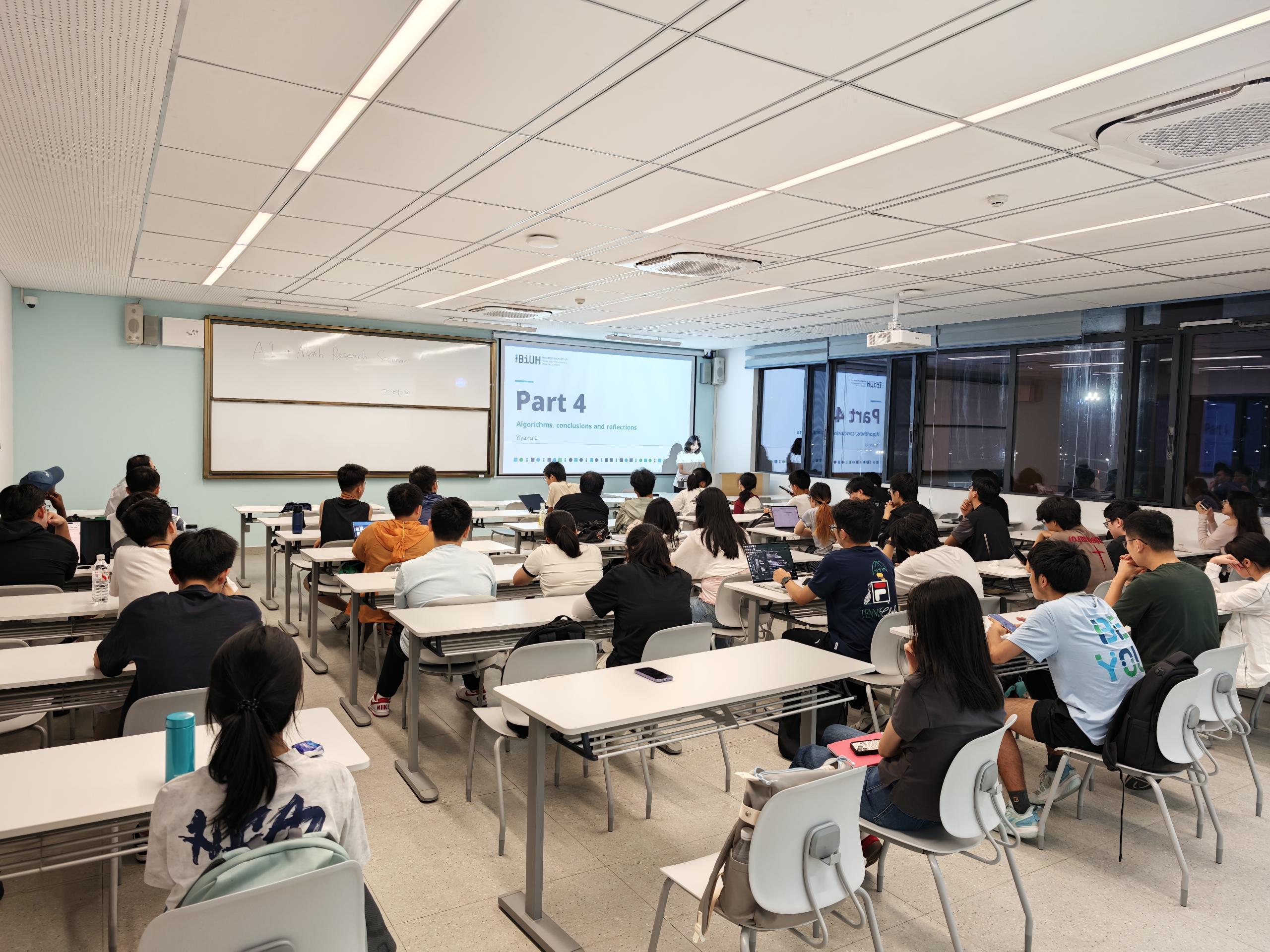
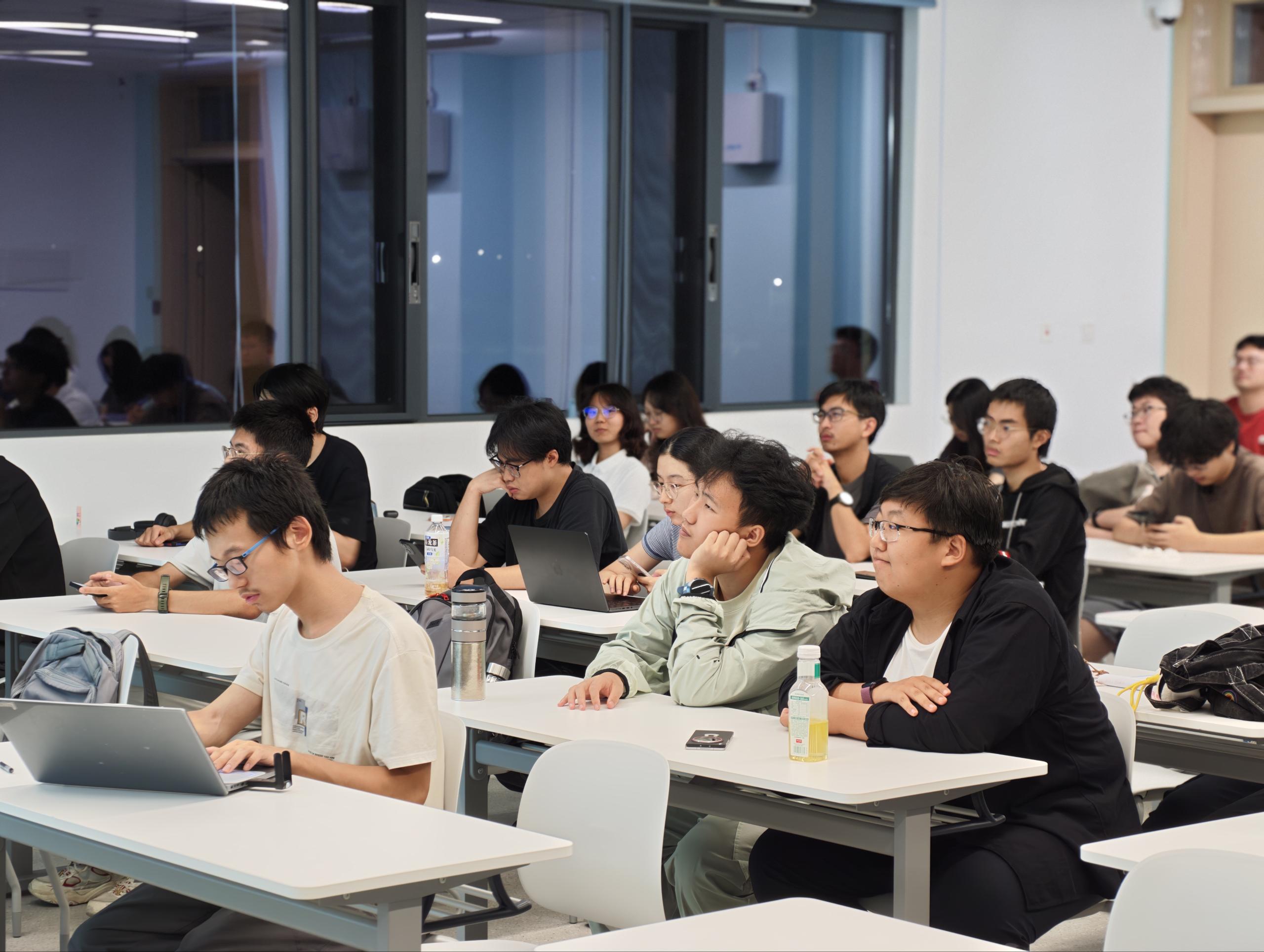
At 7 p.m. on 30 October 2026, the Department of Fundamental Sciences at Hainan Bielefeld University of Applied Sciences (BiUH) held its first Student Research Seminar, featuring a Math+AI project showcase, in Room A309 of the Teaching Building. Four second-year students from the CS, DT and IE programs—JIANG Jiang, JIANG Yuhan, LI Yiyang and ZHANG Aitao —presented two research papers they had contributed to under the guidance of Dr. WANG Lujia. Both papers are publicly available as preprints on arXiv and have not yet been formally accepted or published by a journal. Focusing on chromatic villainy, a problem in graph theory, the students shared the discoveries and personal growth that emerged from their research.
The project began in early September and ran for two months under the leadership of Dr. WANG Lujia of the Department of Fundamental Sciences. The department provided financial support through its departmental funding, while the faculty team provided academic and technical support. As one of the project mentors, Dr. WANG Ruihua participated in the initial training and contributed to discussions and guidance during the research-topic selection stage. Focusing on open problems in combinatorics, the project aimed to develop students’ skills in mathematical reading, programming, computational experimentation and verification of AI-assisted ideas. After passing a selection examination, the four students progressed from foundational study to choosing a research problem, exploring it with AI, checking proofs and writing papers. They then brought their findings together in an academic poster and a research presentation.
Research alongside rapid advances in AI mathematics
The project coincided with rapid advances in AI mathematics. In May 2026, OpenAI announced an AI-generated disproof of the Erdős unit distance conjecture. An AI-generated proof of the cycle double cover conjecture was made public in July, followed by expository papers by mathematicians. In September, an AI-generated solution to the Navier–Stokes Millennium Prize Problem was released alongside a formalization in Lean. October brought a further collection of AI-generated results across several areas of mathematics.
From longstanding open problems in combinatorics to Millennium Prize Problems, AI is becoming an important tool in mathematical research. New results also require researchers to analyze, verify and understand them. Against this background, the BiUH Math+AI project gave undergraduates a concrete problem through which to experience both the help AI can offer and the work that researchers themselves must undertake.
From foundational study to the evening presentation
Training began with basic concepts and methods in graph theory and combinatorics. Students and faculty also discussed the AI-generated proof of the cycle double cover conjecture, working through its reasoning to understand how definitions are used, which conditions each step requires and how different methods fit together. AI also helped the team find and choose a research problem. By considering its assessments of candidate problems and discussing them further, they gradually settled on chromatic villainy. The team then used AI to explore ideas and carry out calculations, repeatedly checked the proofs and developed the work into two papers.
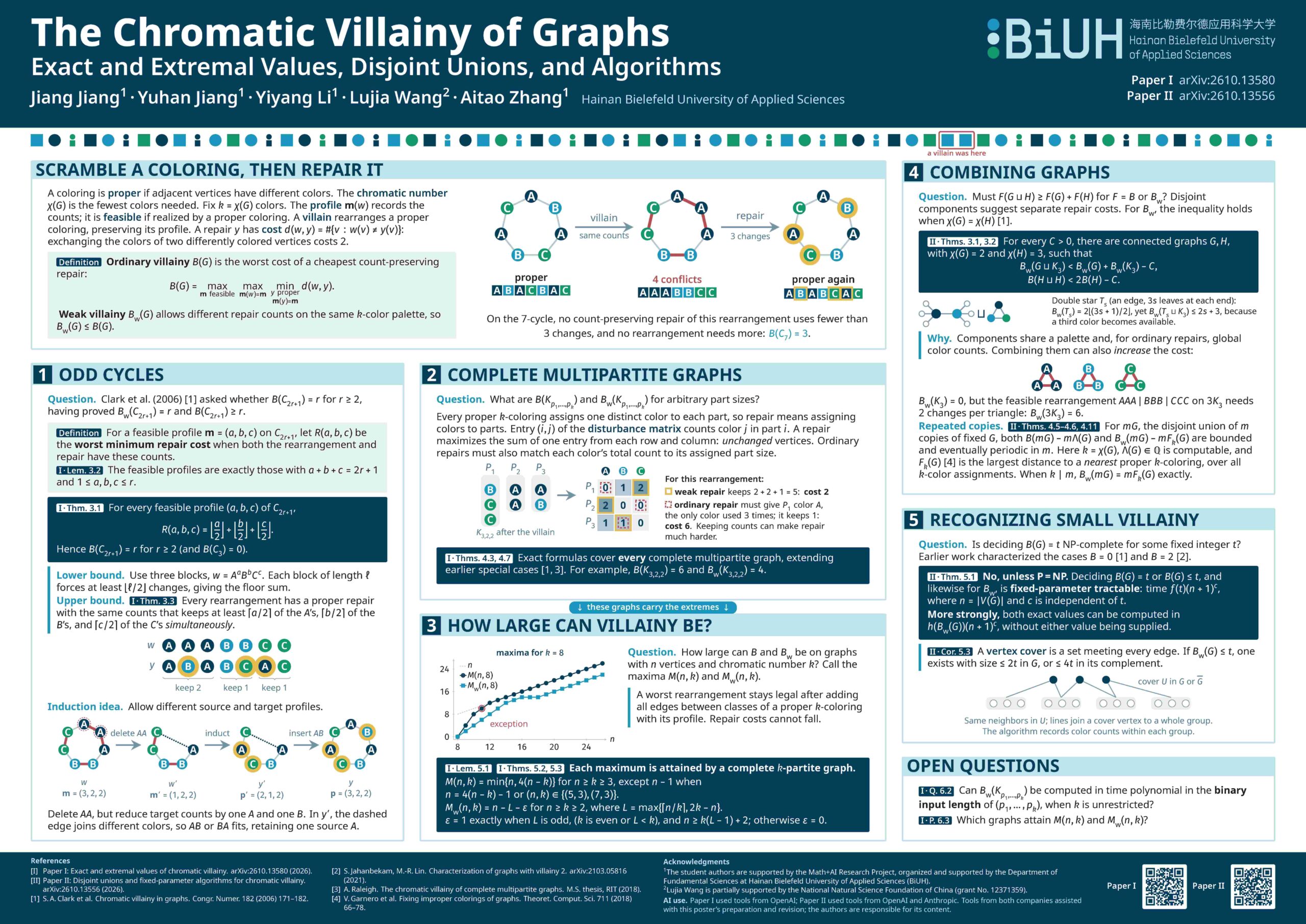
Those two months of thinking came together in the definitions, examples and proofs presented on 30 October. ZHANG Aitao (IE) opened the evening’s report with confidence and poise, introducing the shared research question through simple coloring rules. A proper coloring of a graph assigns a color to each vertex so that adjacent vertices have different colors. Suppose we start with an optimal proper coloring, using as few colors as possible, and rearrange the colors while preserving the number of vertices of each color. What is the minimum number of vertices whose colors must change to restore a proper coloring with the same color multiplicities? Chromatic villainy is the largest such minimum, taken over all optimal proper colorings and all rearrangements of their colors.
The repair cost counts vertices whose colors change, and the repair must preserve every color multiplicity. Consider a path on five vertices with proper coloring A–B–A–B–A. Rearranging it to B–A–B–A–A creates just one monochromatic edge, at the end of the path. Yet restoring a proper coloring while retaining three A’s and two B’s requires changing the colors of four vertices. Through simple examples of this kind, Aitao showed how a local conflict can affect the entire distribution of colors, preparing the audience for the results that followed.
Surprising findings on odd cycles and disjoint unions
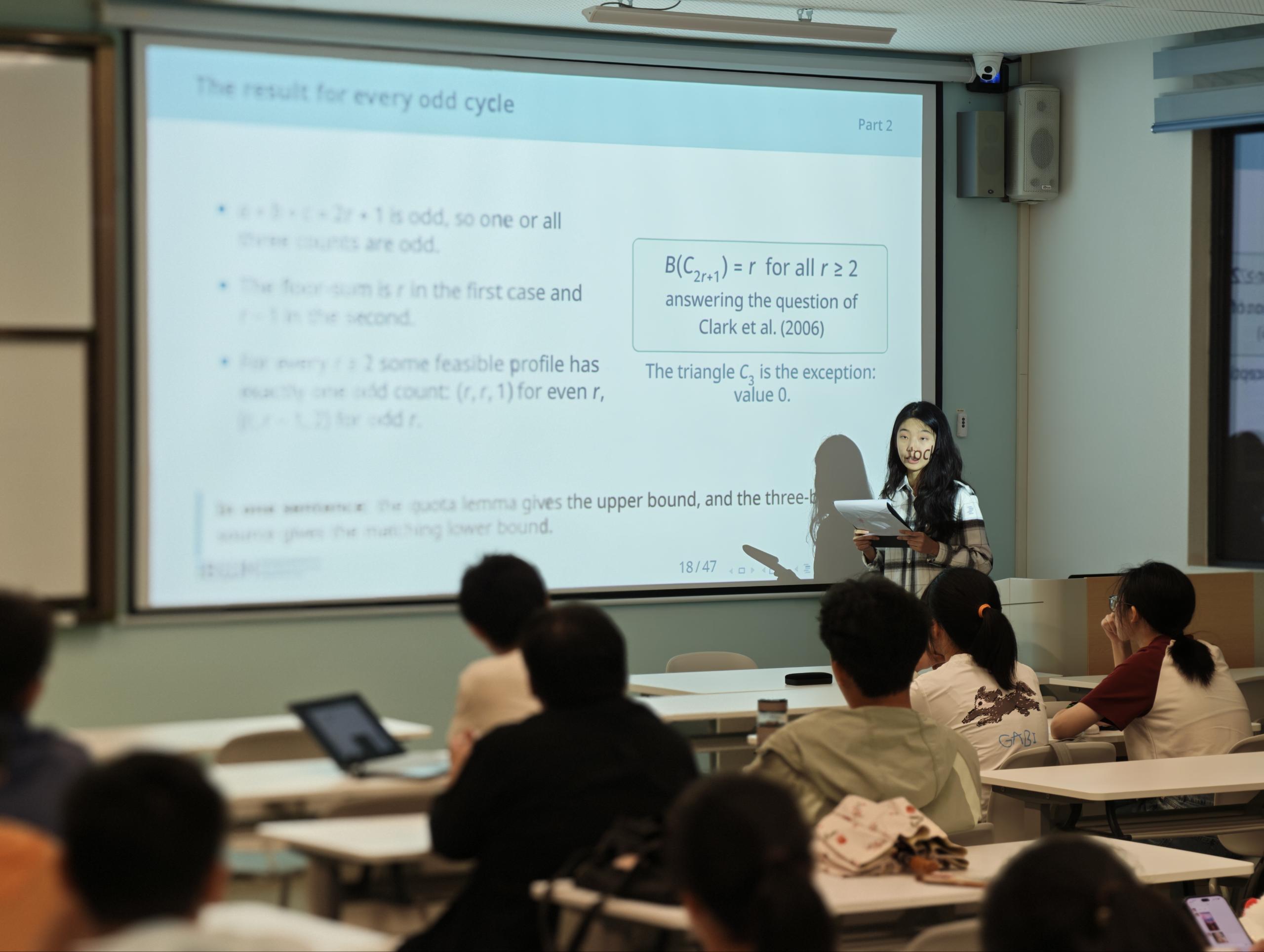
JIANG Yuhan (DT) took the discussion further with the team’s exact result for odd cycles, using examples to explain the main ideas of the proof. In 2006, Clark and coauthors asked for the exact value of chromatic villainy on odd cycles. Twenty years later, the team has given a complete answer: for every odd cycle with at least five vertices, its villainy equals (n – 1)/2, where n is the number of vertices. Cycles on five, seven and nine vertices therefore have villainy 2, 3 and 4, respectively.
For a seven-vertex cycle, this means that any rearrangement of the colors of an optimal proper coloring can be repaired by changing the colors of at most three vertices, while preserving every color multiplicity. Some rearrangements require all three changes. The proof therefore provides a repair guarantee and shows that the bound cannot be improved. Taking part in this work taught Yuhan the importance of confidence: it helped her keep asking questions when faced with unfamiliar concepts and difficult proofs, while understanding the details for herself gave that confidence a firmer foundation.
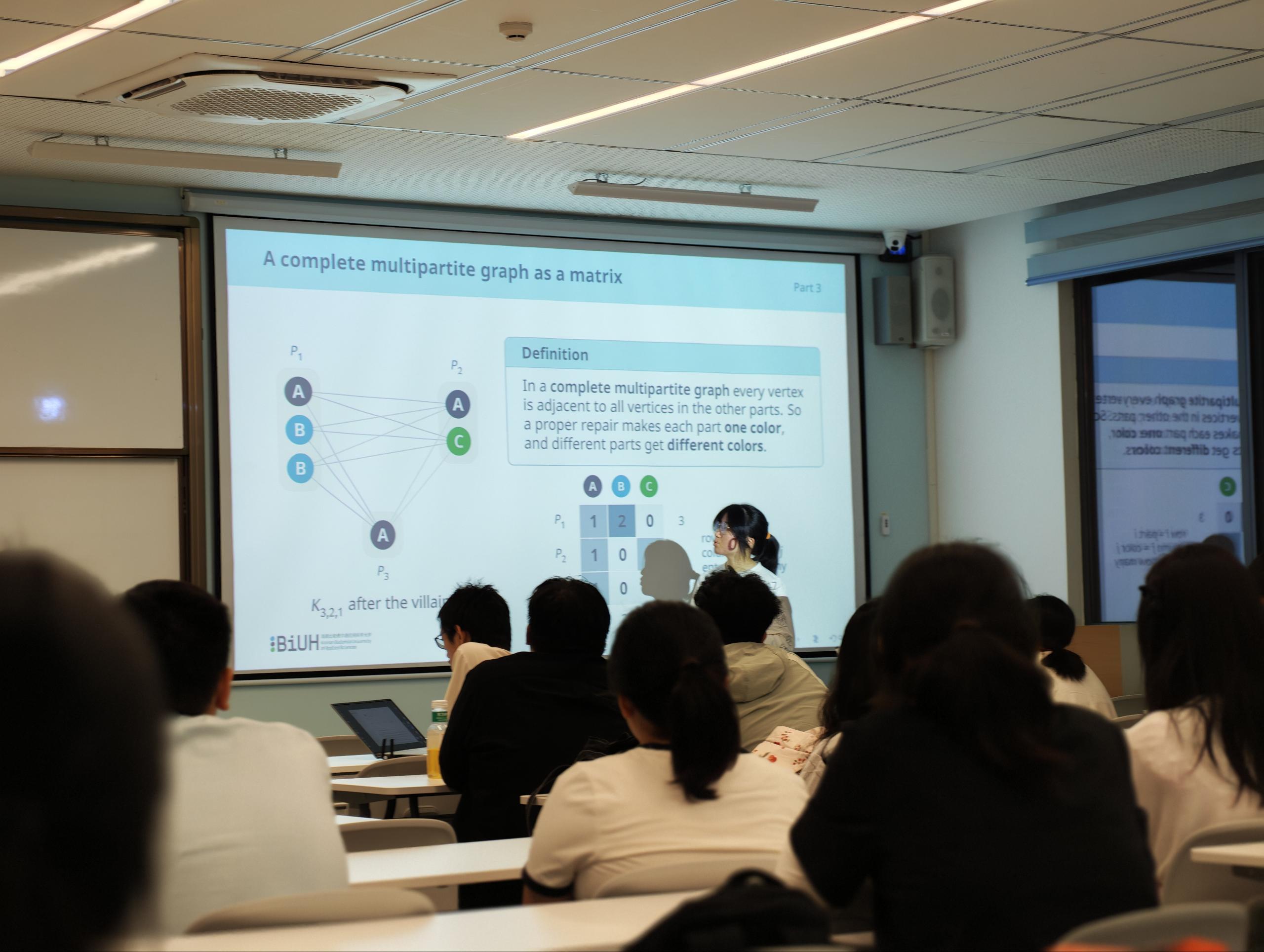
JIANG Jiang (CS) then turned to more complex color rearrangements and combinatorial structures, moving from matrix representations of complete multipartite graphs to disjoint unions. What happens to repair difficulty when two graphs are placed together without adding any edges between them? In the variant called weak chromatic villainy, repairs may change color multiplicities while retaining the palette of an optimal coloring of the graph under consideration. Here, villainy can actually decrease. A tree consisting of two adjacent central vertices, each with nine leaves, has weak villainy 10. After taking its disjoint union with a triangle, the resulting graph has weak villainy at most 9. The reason is that the chromatic number of the whole graph increases from two to three, and the additional color creates new repair possibilities.
Even when every color multiplicity must be preserved, the repair cost of the whole need not equal the sum of the costs of its parts. The team constructed a graph with villainy 12 whose disjoint union with an identical copy has villainy at most 22, less than 12 plus 12. Jiang’s explanation revealed the connection behind this surprising result: apparently independent parts can affect each other through the total color counts and the distribution of colors between them. Local structure and global constraints must be understood together.
algorithms with network resilience
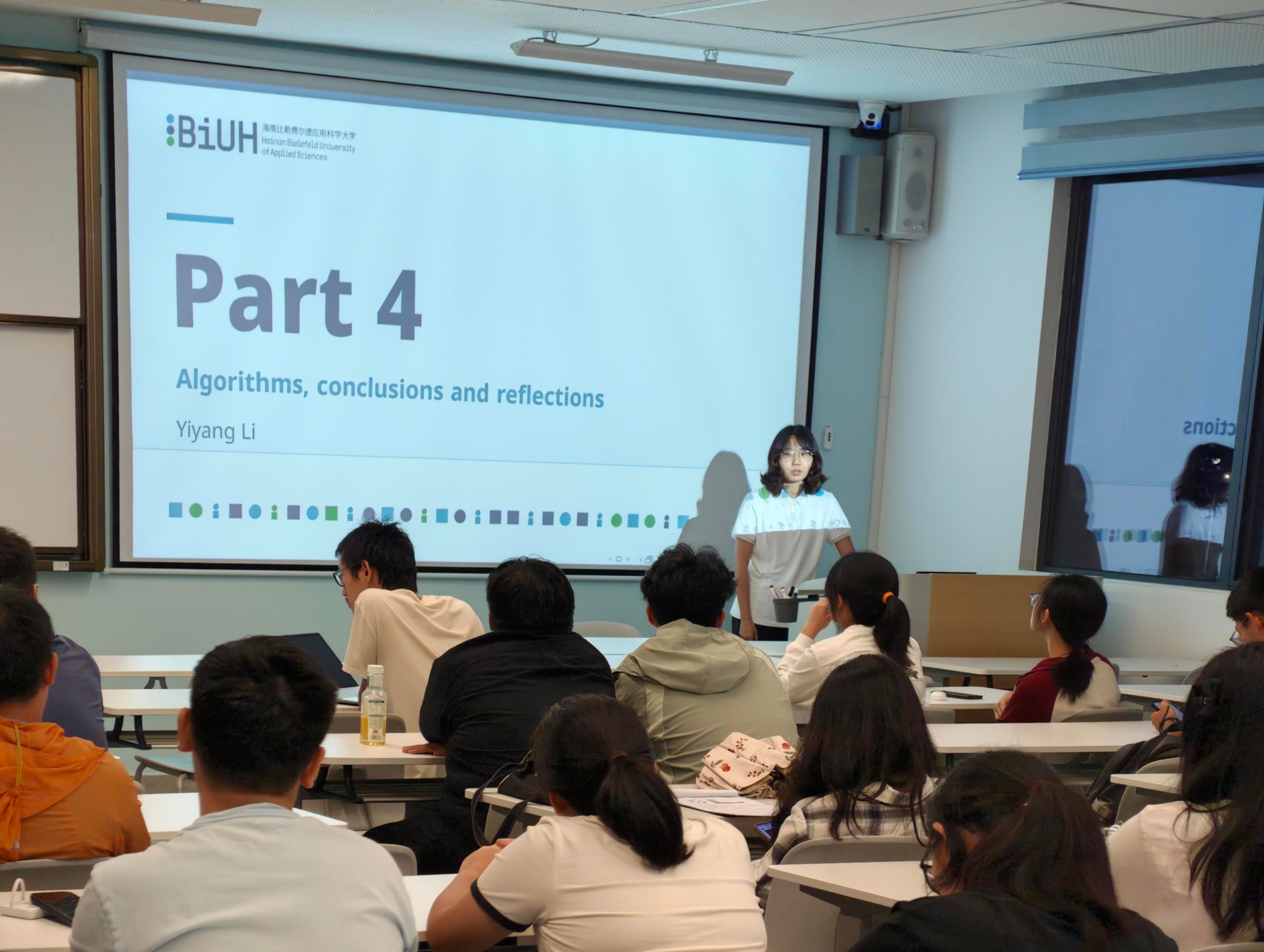
Moving from graph structure to computation, Yiyang Li (DT) drew on her understanding of the P versus NP question to discuss the distinction between efficiently finding a solution and efficiently checking one. She then presented the team’s algorithmic results. For every fixed integer threshold, whether a graph’s villainy equals or is at most that threshold can be decided in time polynomial in the size of the graph. The team also obtained fixed-parameter tractable (FPT) algorithms: dependence on the threshold is separated from polynomial dependence on graph size, with the polynomial exponent independent of the threshold. These results clarify the computational complexity of the problem.
LI Yiyang also discussed potential applications to network resilience. In networks that can be modeled by graph coloring, colors may represent frequency bands, time slots or resource categories, while the requirement that adjacent vertices have different colors represents a conflict constraint. In such a model, chromatic villainy offers a way to characterize network resilience through repair cost. It measures the minimum number of nodes that must be reconfigured to restore a valid configuration after the worst possible color rearrangement. Under the same disturbance and repair rules, a larger value means a higher worst-case recovery cost.
In adversarial network settings, she explained, understanding both one’s own capacity for recovery and the structure and recovery difficulty of an opposing network can inform protection and resource allocation. This perspective also raises a concrete question for further research: how can color quotas and disturbance rules in the model be matched to the constraints of a real system? Reflecting on the project, Yiyang shared the surprise and excitement of scientific discovery. A problem combining a worst-case disturbance with an optimal repair had yielded these algorithmic results. That unexpected finding became a reason to keep exploring.
Insisting on real understanding in the age of AI
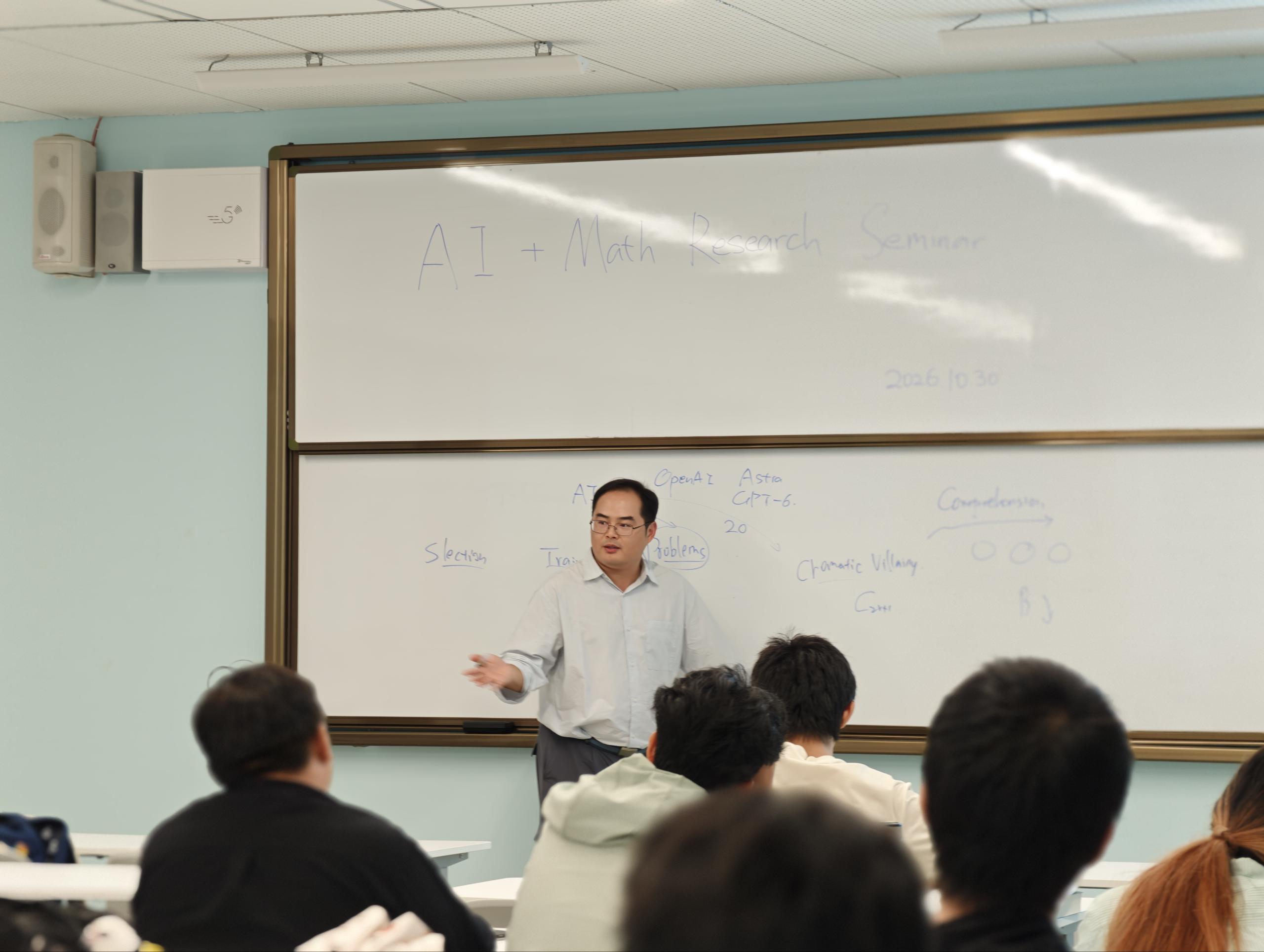
The four students’ presentations shared research results and naturally led to a further question: what does it mean to understand those results for oneself? After the students spoke, project leader Dr. WANG Lujia discussed examples of mathematical research in the age of AI and the need for independent judgment as AI becomes more involved in research and everyday life. He summed up his central message as “be real”: engage honestly with the problem and with the limits of one’s own understanding.
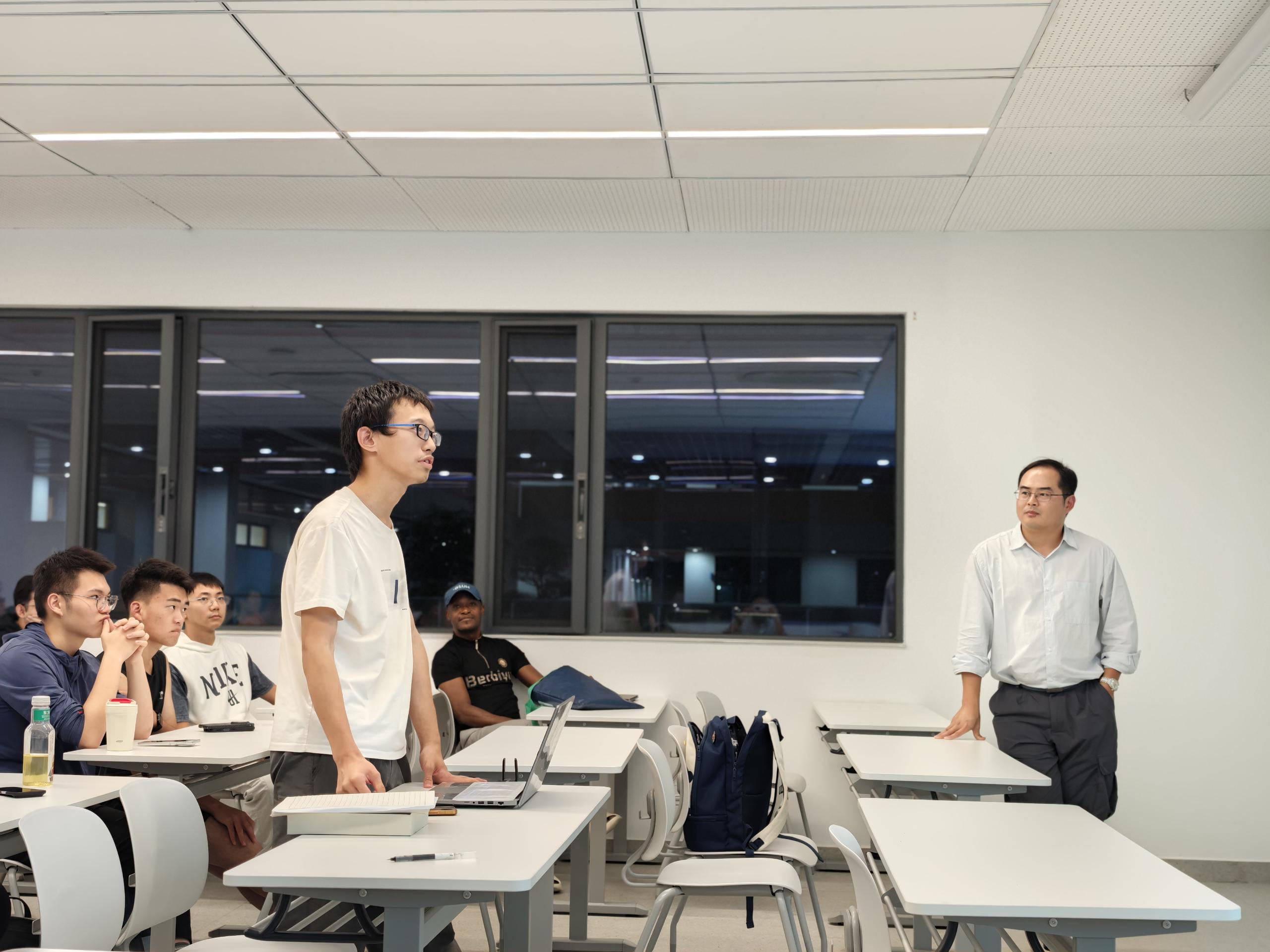
In mathematics, this means carefully unpacking AI-generated proofs, checking whether definitions have been applied correctly, identifying the assumptions behind each deduction and testing seemingly natural generalizations for counterexamples. Explaining key steps in one’s own words and answering questions about them are concrete tests of understanding. The project papers reflect this responsibility: both disclose the use of AI assistance and state that the authors remain responsible for the proofs, computations and conclusions. Tools can open up ideas and accelerate exploration, but understanding a proof and judging whether an argument is valid remain the researcher’s work.
WANG also cautioned that relying on AI to “fake it” does not mean one will “make it.” When a result looks complete but its author cannot explain why it holds, the appearance of accomplishment may fail to become real ability or confidence, and may even lead to a crisis of meaning. As AI becomes more deeply involved in research and everyday life, what a person actually understands and can judge independently is what defines their personal development and level of contribution. For the four students, the project offered a practical opportunity to develop that understanding while working with AI.
Mathematical books for the next stage of exploration
This emphasis on understanding and thoughtful inquiry also shaped the project’s support for further learning and research. The project provided the four students with mathematics reference books in their original English editions, offering reading and reference materials for continued mathematical study and further research related to the project. From the classic proofs in Proofs from THE BOOK to the mathematical problems in The Art of Mathematics, these books opened up further avenues for exploration. They encourage the students to sustain the patience and curiosity developed during the project, use their imagination, and pose and explore new questions through further reading.
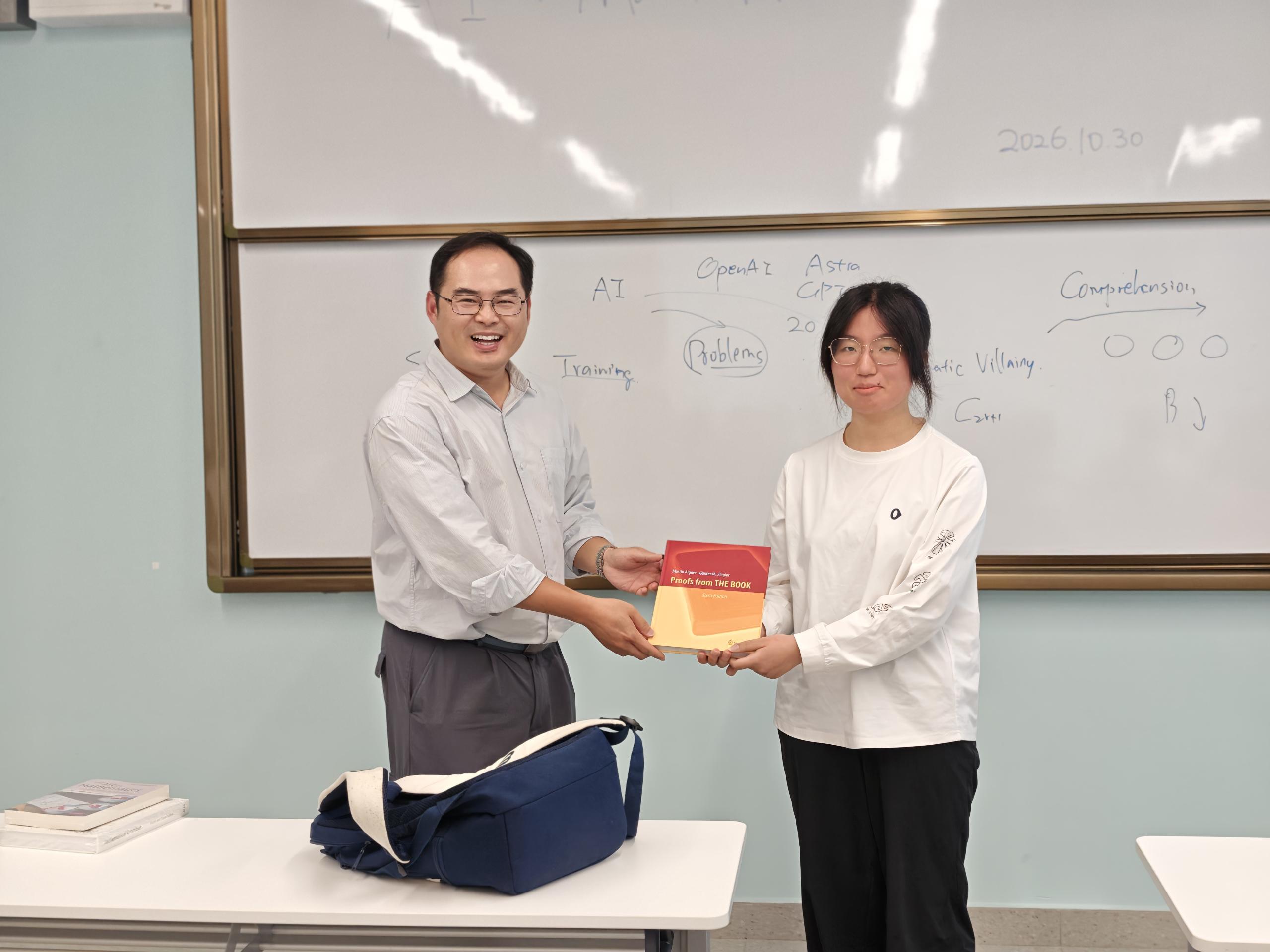
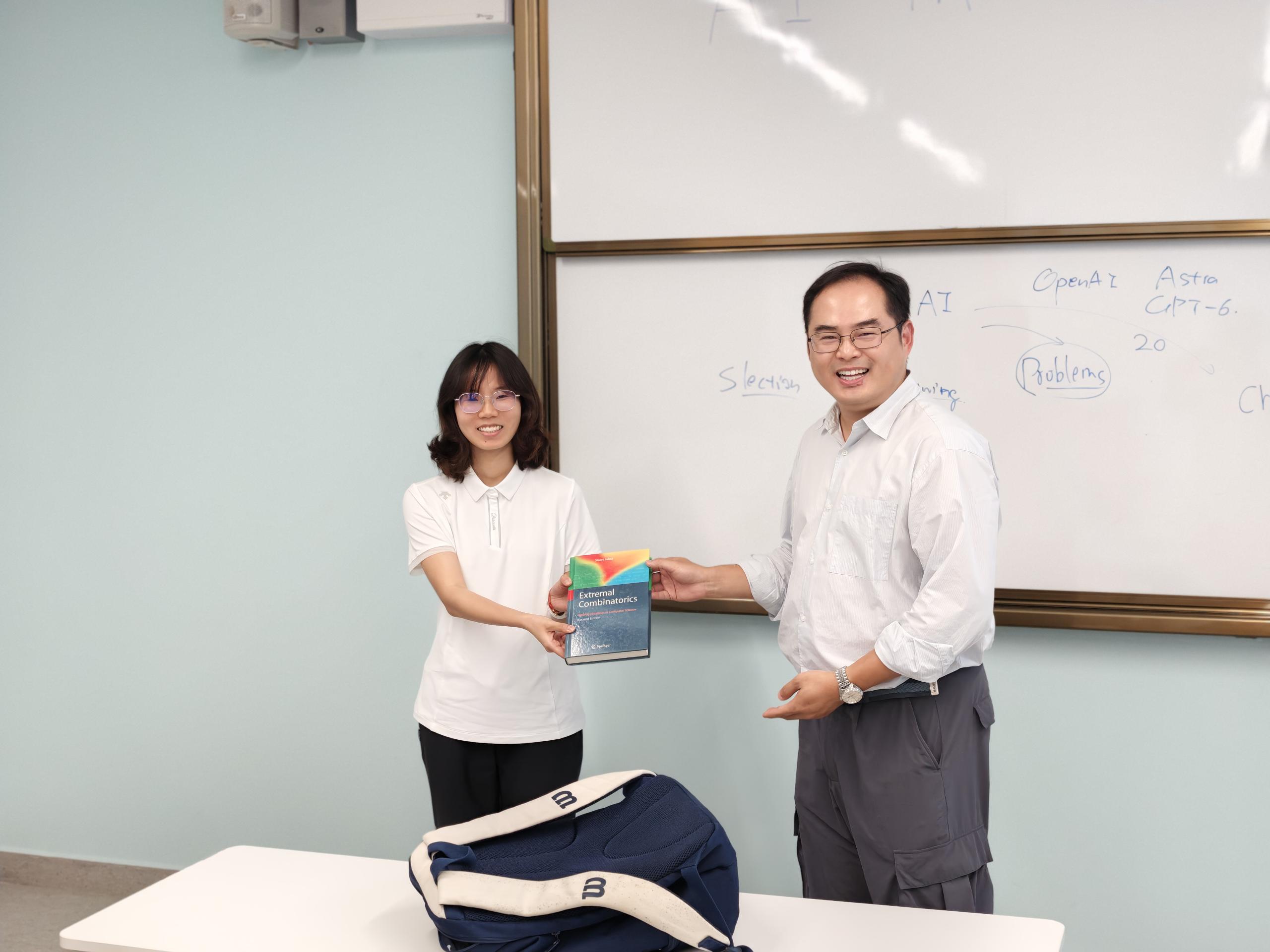
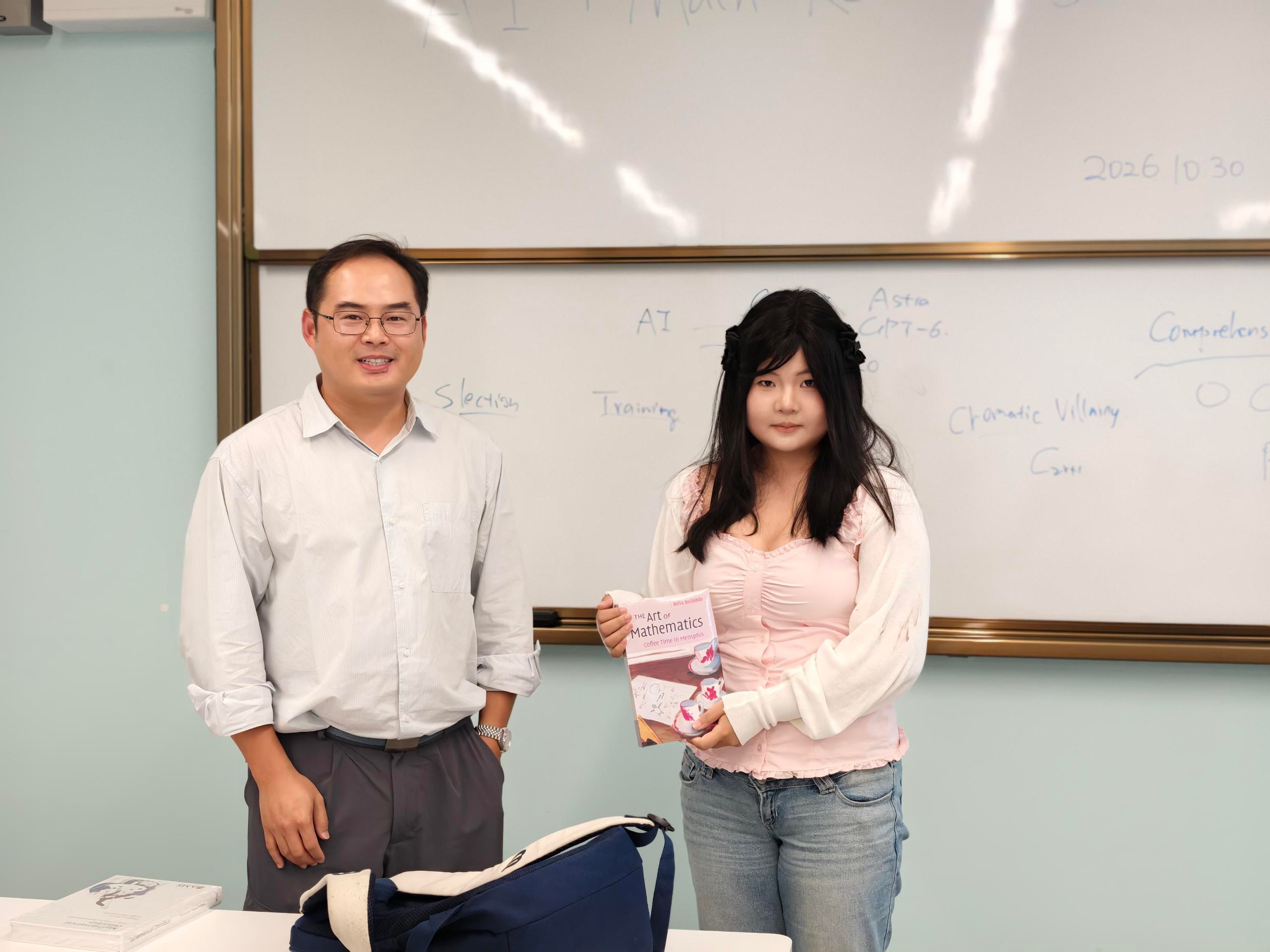
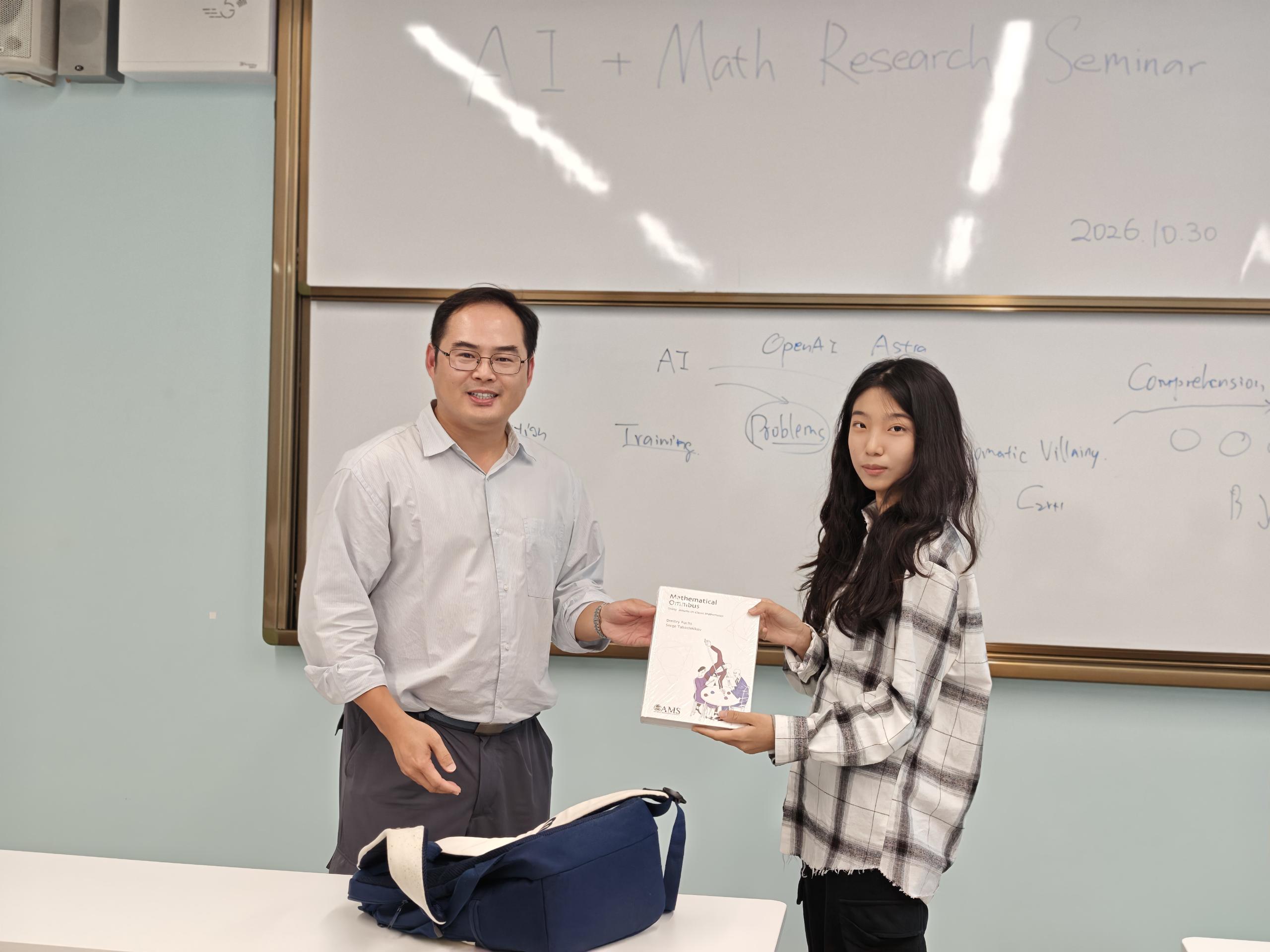
Support from the Department of Fundamental Sciences and the supervising faculty gave the students an opportunity to engage with real research questions as undergraduates and to follow the full process from foundational study to communicating their findings. The Student Research Seminar showcased both the interim findings and the shared process of learning, discussion and repeated verification by students and faculty. We thank the students and faculty who took part and congratulate the four students on completing this stage of their work. We look forward to seeing them pursue new questions and carry the knowledge and judgment they have developed into future study and research. Asking questions carefully, understanding proofs for oneself and taking responsibility for one’s results are the lasting lessons this project hopes to leave in the age of AI.
Further reading
1. Exact and extremal values of chromatic villainy
2. Disjoint unions and fixed-parameter algorithms for chromatic villainy