
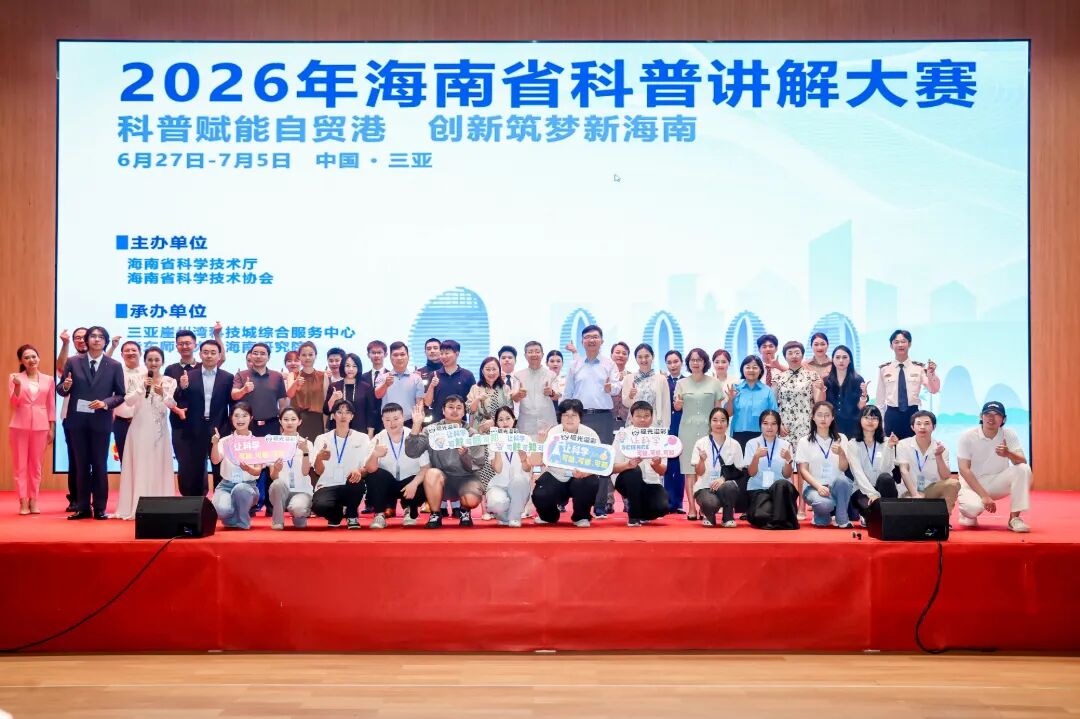
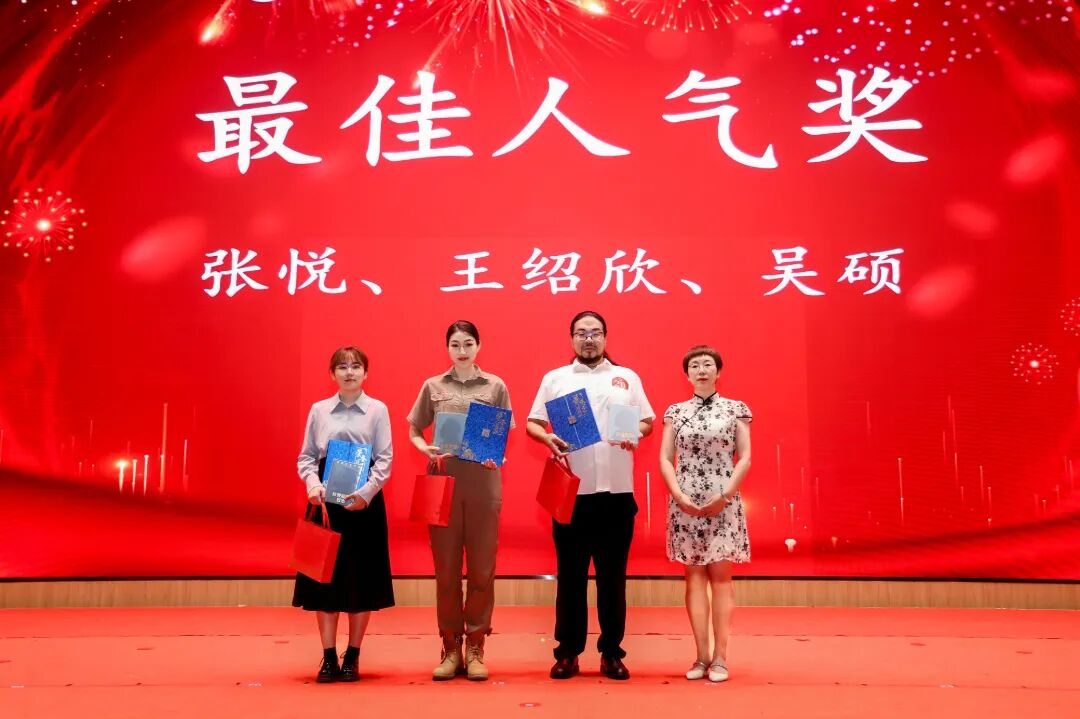
The final of the 2026 Hainan Provincial Science Communication Competition concluded successfully in Sanya on 5 July. With support from the university’s Academic Affairs Office, Associate Professor Zhang Yue, Head of the Department of Fundamental Sciences at Hainan Bielefeld University of Applied Sciences (BiUH), represented the university in the competition. Drawing on his strong academic background, engaging communication style, and compelling presentation, he won Third Prize and received the highest number of votes in the online poll, earning the competition’s Most Popular Presenter Award.
These honours recognise not only Associate Professor Zhang’s commitment to science communication, but also the Department of Fundamental Sciences’ broader mission to draw on its strengths in mathematics and physics, bring fundamental science beyond the classroom, serve society, and inspire the next generation.
The 2026 Hainan Provincial Science Communication Competition was jointly organised by the Hainan Provincial Department of Science and Technology and the Hainan Association for Science and Technology, and hosted by the Sanya Yazhou Bay Science and Technology City Comprehensive Service Centre. It is one of Hainan Province’s most influential science communication events.
Under the theme “Science Communication Empowers the Free Trade Port; Innovation Shapes a New Hainan,” this year’s competition attracted more than 120 participants from universities, research institutions, technology companies, science museums, and other science-related organisations. Following the preliminary round, 20 contestants advanced to the final, where they demonstrated their scientific knowledge, communication skills, and ability to think on their feet through both prepared and impromptu presentations.
More than a platform for science communicators to exchange ideas and showcase their work, the competition serves as an important bridge through which scientific knowledge reaches society and the spirit of science connects with the public. What it conveys is not simply a collection of scientific facts, but a deeper commitment to evidence, truth, curiosity, and the courage to explore the unknown.

Associate Professor Zhang’s presentation was entitled Losing the Self—The Mystery of Quantum Entanglement Behind Micius.
Set against the story of Micius, China’s quantum science satellite, the presentation used quantum entanglement as a point of entry into the frontier of modern physics. Through storytelling, multimedia, and vivid analogies, Associate Professor Zhang transformed abstract quantum theory into an accessible and engaging scientific narrative, inviting the audience to appreciate the logical beauty, intellectual depth, and spirit of exploration embodied in the quantum world.
Reflecting on the purpose of science communication, Associate Professor Zhang said: Science communication is not about making science shallow; it is about building the first bridge that leads the public towards its deeper ideas. What truly matters is not simply helping someone understand a quantum concept, but inspiring a child, at a particular moment, to wonder, “Why does this happen?” The future of science often begins with a question born of such curiosity.
Through the presentation, he hoped to enable more members of the public—particularly young students and their parents—to encounter and appreciate fundamental science, to plant within them a seed of curiosity about the unknown, and ultimately to encourage more young people to pursue serious and sustained scientific exploration.
Science communication is an essential part of a university’s contribution to society. As a key academic platform responsible for foundational teaching, fundamental research, and public engagement at BiUH, the Department of Fundamental Sciences not only develops and delivers the university’s core mathematics and physics courses, but also embraces the wider social responsibilities of education in the fundamental sciences.
The value of such education lies not only in providing the knowledge on which students’ specialised studies are built. It also lies in cultivating logical thinking, intellectual rigour, a commitment to truth, and the confidence to explore. These qualities form an essential foundation for scientific and technological innovation, while also enabling young people to understand the world and navigate an uncertain future.
In recent years, the Department of Fundamental Sciences has continued to explore new ways in which mathematics and physics can serve both the university and wider society. Through public science presentations, academic exchange, student innovation projects, and academic competition mentoring, the Department has worked to bring fundamental science from the classroom into the wider university community, and from the campus into the public sphere. In doing so, it seeks to make scientific knowledge a shared cultural resource that society can understand, experience, and value.
The Department’s participation in the Hainan Provincial Science Communication Competition represents a concrete example of its efforts to harness its disciplinary strengths, fulfil the university’s public-service mission, and contribute to the development of a vibrant scientific culture in the Hainan Free Trade Port. It also reflects the Department’s guiding commitment: “Serving society through science education and empowering the future through fundamental science.”
In the same month as the competition, Chinese mathematicians Hong Wang and Yu Deng were awarded the 2026 Fields Medal, marking the first time that Chinese nationals had received one of the highest honours in international mathematics.
Hong Wang has made major contributions to harmonic analysis and geometric measure theory, while Yu Deng has produced outstanding work in partial differential equations. Although their research lies at the frontiers of pure mathematics, it is deeply connected to physical questions involving wave propagation, the behaviour of microscopic particles, and the emergence of macroscopic physical laws. Their achievements once again demonstrate the power of mathematics and physics to reinforce one another and jointly advance humanity’s understanding of the world.
Their work also reminds us that fundamental disciplines such as mathematics and physics are not abstract bodies of knowledge detached from reality. Rather, they provide the intellectual foundations through which humanity understands nature, drives technological transformation, and opens new paths towards the future.
Breakthroughs at the frontiers of global science and the communication of scientific ideas to the public take place at different levels, yet together they reveal the dual mission of fundamental science: to extend the boundaries of human knowledge and to pass the spirit of science on to society and future generations.
As a new wave of technological transformation—driven by artificial intelligence, quantum technologies, advanced manufacturing, and other emerging fields—continues to gather pace, the importance of fundamental science is not diminishing; it is becoming more pronounced. The further technology advances, the more it depends on strong foundations in mathematics and physics. The more uncertain the future becomes, the more society needs rational inquiry, a commitment to truth, and the courage to question accepted assumptions.
We may be standing at the threshold of a new golden age of science. Yet a true golden age cannot be created by the world-changing breakthroughs of a small number of exceptional scientists alone. It also requires a society that respects and values science—and, above all, successive generations of young people who are moved by scientific ideas, captivated by the unknown, and willing to transform their curiosity into the courage to keep exploring.
The responsibility of a university is to protect that curiosity, cultivate that intellectual rigour, and provide young people with pathways towards scientific discovery and technological innovation.
Looking ahead, the Department of Fundamental Sciences at Hainan Bielefeld University of Applied Sciences will continue to draw on the strengths of its international faculty and interdisciplinary academic environment. Through science communication, academic exchange, and public engagement, the Department will further integrate education in the fundamental sciences with talent development, technological innovation, and social progress.
Its ambition is to inspire more young people to fall in love with science through a single presentation, a compelling question, or a memorable experiment—and, through the power of university education, to contribute to the development of the Hainan Free Trade Port and China’s wider scientific and technological future.